There is no good time for an economy to face an energy- and food-price shock, but some moments are worse than others.
And for the United States today – with its strained credit market, stretched equity-price valuations, unsustainable public finances, and inflationary import-tariff policy – now is about as bad as it gets.
The precise magnitude of the shock the US will face as a result of its war of choice in Iran is difficult to predict, given the array of factors at play.
But Iran’s effective closure of the Strait of Hormuz, through which 20% of the world’s oil and 20-30% of its fertilizer pass, suggests that the fallout could be severe.
Attacks on energy infrastructure in Iran and across the Gulf threaten to deepen and prolong the shock.
Consider the damage to Qatar’s liquefied natural gas facilities: 17% of the country’s LNG export capacity has been wiped out, and it will take up to five years to repair the damage.
Goldman Sachs now projects that Brent oil prices will average $85 a barrel in 2026, as a result of what it calls the largest-ever supply shock for the global crude market.
Financial-sector fragility
The US is poorly equipped to weather this shock, and financial-sector fragility is a key reason why.
Financial crisis has been a common feature of previous post-war recessions.
This makes recent admonitions about the tenuous state of US credit markets – especially the $3 trillion private credit market, which operates outside the traditional banking system – deeply ominous.
A downturn in the market could lead to a wave of bankruptcies
Last October, JPMorgan Chase CEO Jamie Dimon warned that “cockroaches” lurked in the private credit market – “when you see one cockroach, there’s probably more” – noting that a downturn in the market could lead to a wave of bankruptcies.
More recently, he expressed “anxiety” about a coming credit cycle, which will be “worse than a normal one,” owing to lofty asset prices, high debt levels, and excessive complacency among lenders.
Such a downturn could begin with the software sector – a favored recipient of private credit, whose business model is under threat from AI.
Stock market
Another source of recession risk is the stock market. By virtually every standard measure, US stock-market valuations are at historic highs.
Such frothy valuations are often indicative of bubbles, which have often ended badly for the real economy.
Compounding the risks today is the US stock market’s unprecedented concentration.
A stock-market correction – or, worse, the collapse of an AI bubble – could prove catastrophic
As few as ten companies – mostly tech giants – account for nearly 40% of the S&P 500’s total value.
Moreover, AI-related stocks have delivered a whopping 75% of the S&P 500’s returns since 2022, and AI investments accounted for over 90% of US GDP growth last year.
A stock-market correction – or, worse, the collapse of an AI bubble – could prove catastrophic.
Interest rates
The last thing a shaky credit market and an overvalued stock market need is higher long-term interest rates.
After all, higher rates make it more difficult for troubled companies to roll over their maturing loans, while giving investors an alternative to stocks and raising the rate at which companies’ future earnings will be discounted.
But as the Iran war drives up energy and food prices – threatening to compound the inflationary pressures already being generated by high and unpredictable import tariffs – this is precisely the situation the US faces.
At its most recent meeting, the Federal Open Market Committee voted nearly unanimously to hold interest rates steady, with Federal Reserve Chair Jerome Powell noting that the war has increased near-term measures of inflation expectations.
Markets now view interest-rate hikes as significantly more likely than the cuts that were expected before the war began
Markets now view interest-rate hikes as significantly more likely than the cuts that were expected before the war began.
After the Fed’s decision, Treasury yields spiked, with the all-important ten-year Treasury increasing nearly 11 basis points, to 4.39%.
The rise in ten-year bond yields since the war began represents a notable departure from investor behavior during past episodes of uncertainty, when US Treasuries represented a safe haven.
Public finances
The rapid deterioration of US public finances further increases the likelihood of interest-rate hikes.
Before the war, the Congressional Budget Office estimated that the US budget deficit would amount to $1.9 trillion this year and rise to an eye-watering $3.1 trillion – 6.7% of GDP – in a decade.
This would have put the deficit at around 6% of GDP, on average, over the next ten years – double the level (around 3% of GDP) generally considered to be consistent with public-debt stability.
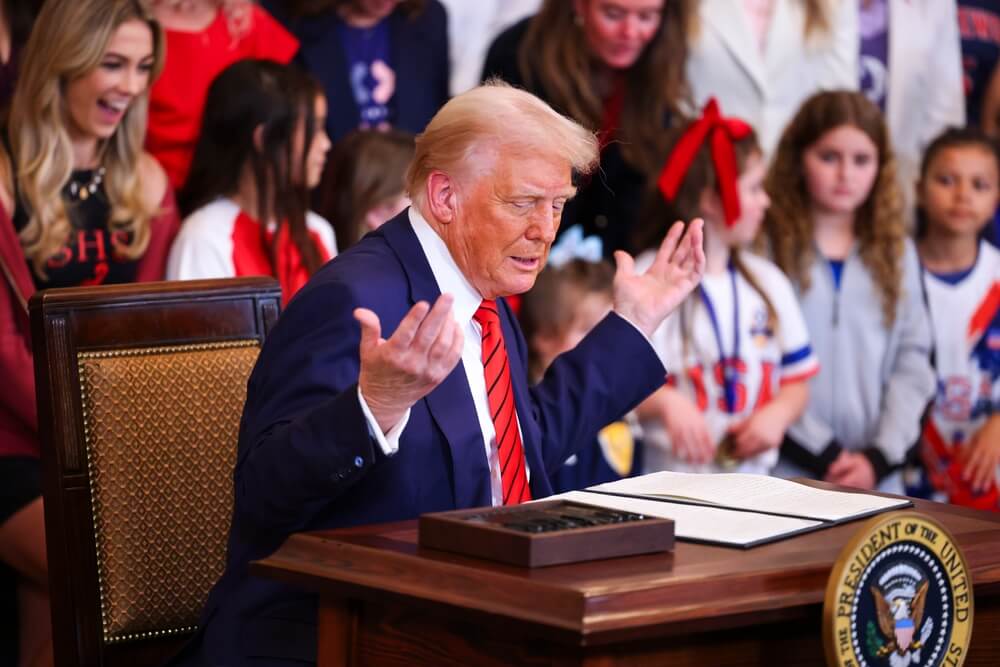 Donald Trump is now asking Congress to approve a $200 billion increase in the defense budget
The war has made matters much worse. Beyond the tens of billions of dollars that have already been spent, US President Donald Trump is now asking Congress to approve a $200 billion increase in the defense budget.
And there is no reason to think the costs will end there, not least because the Iran war may embolden powers like China and Russia to ramp up their own military adventurism.
When the investment firm Lehman Brothers collapsed in September 2008, the US government and the Fed were caught off-guard, triggering a global financial crisis and a severe US recession.
Today, with all the signs of another major economic downturn flashing red, there is no excuse to repeat this mistake.
At a minimum, Trump should be rolling back his import tariffs and suspending all attacks on the Fed’s independence.
The Fed will have its hands full, not least preparing for the possibility that it will have to come to the financial sector’s rescue.
Desmond Lachman, a senior fellow at the American Enterprise Institute, is a former deputy director of the International Monetary Fund’s Policy Development and Review Department and a former chief emerging-market economic strategist at Salomon Smith Barney.
