“Rupture” is a strong word, defined as “an instance of breaking or bursting suddenly or completely.”
Yet it is the term that Canadian Prime Minister Mark Carney used at Davos last week when he warned of a “rupture in the world order, the end of a pleasant fiction and the beginning of a harsh reality, where geopolitics… is submitted to no limits, no constraints.”
But Carney’s speech was not a despairing one, because he made a second major point. “[O]ther countries, especially intermediate powers like Canada, are not powerless,” he observed. “They have the capacity to build a new order that encompasses our values, such as respect for human rights, sustainable development, solidarity, sovereignty, and territorial integrity of the various states.”
What should that order look like? In what now seems like another century (though it was only 16 months ago), United Nations member states concluded “Pact for the Future,” and in preparation for its signing, UN Secretary-General António Guterres convened high-level commissions and boards (including one on which I served) to identify the elements of “effective multilateralism.”
Effective multilateralism refers to cooperation among multiple countries that can get things done: stopping war; enforcing peace; protecting people from manmade and natural disasters and caring for them in the aftermath; and establishing regional or global rules on subjects ranging from digital technology and nuclear weapons to protecting some of the world’s most beautiful and significant places.
Networked decision-making
Our report, A Breakthrough for People and Planet, laid out ten principles – drawn from extensive consultations and observations of multilateral arrangements that already work well – to help re-orient the current international system “towards more distributed, networked decision-making for our collective well-being.”
The world’s middle powers can use these arrangements as a blueprint. To be effective, multilateralism should be “people-centered,” focused on delivering tangible results not for states but for the “peoples” of the world, as stated in the preamble of the UN Charter.
Multilateral institutions’ impact should be measured from the viewpoint of the people they are designed to help.
Multilateral government by consensus – implying the potential for a veto – does not work
They should be “representative,” reflecting the interests of all stakeholders and, critically, “allowing representative majorities to make and implement decisions in the face of minority opposition where necessary to deliver on issues of global concern.”
In other words, multilateral government by consensus – implying the potential for a veto – does not work.
Majorities can be weighted in various ways, but these must include a diverse range of states – big and small, from different regions or parts of subregions, rich and poor, allied and non-allied to great powers. That is what true representation looks like.
Effective multilateralism
Effective multilateralism is also “transparent, equitable, and networked.” The first is easy to champion, but hard to achieve, because it may require revealing things that can hurt you.
Nonetheless, the legitimacy conferred by transparency has a power of its own. As Carney proclaimed, “the power of the less power[ful] starts with honesty.”
“Equity” in this context means recognizing common but differentiated responsibilities when it comes to rich and poor countries, often former imperial powers and their former colonies.
And “networked” means recognizing the need for collaboration among state and non-state actors to achieve common goals.
Multilateral actors should be future-oriented, responding to current shocks and crises in ways that serve future generations, giving young people a stake in their work
Since networks are horizontal, they can counter the often-stultifying hierarchy of formal international organizations and facilitate coalitions of the willing.
The groupings that succeed are also resourced, mission-focused, and flexible. They need adequate and timely funds to achieve their tasks; they need to know precisely what those tasks are and how to know if they have succeeded or failed; and they need to be able to adapt to changing circumstances.
Such flexibility allows for pilot projects and an exploration of new approaches, even at the risk, perhaps even the likelihood, of failure.
Multilateral groups that have money, a clear mission, and the ability to adapt to changing circumstances still require two final elements for success.
They must be accountable, subject to “common, enforceable rules that cannot be broken with impunity by any actor.”
And multilateral actors should be future-oriented, responding to current shocks and crises in ways that serve future generations, giving young people a stake in their work.
M20
These principles can serve as a guide for reforming current institutions or creating new ones.
In the UN, for example, middle powers can come together and act through the General Assembly, bypassing the Security Council.
That may require radical action, taking it upon themselves (through majority or super-majority votes) to develop practices that de facto amend the UN Charter.
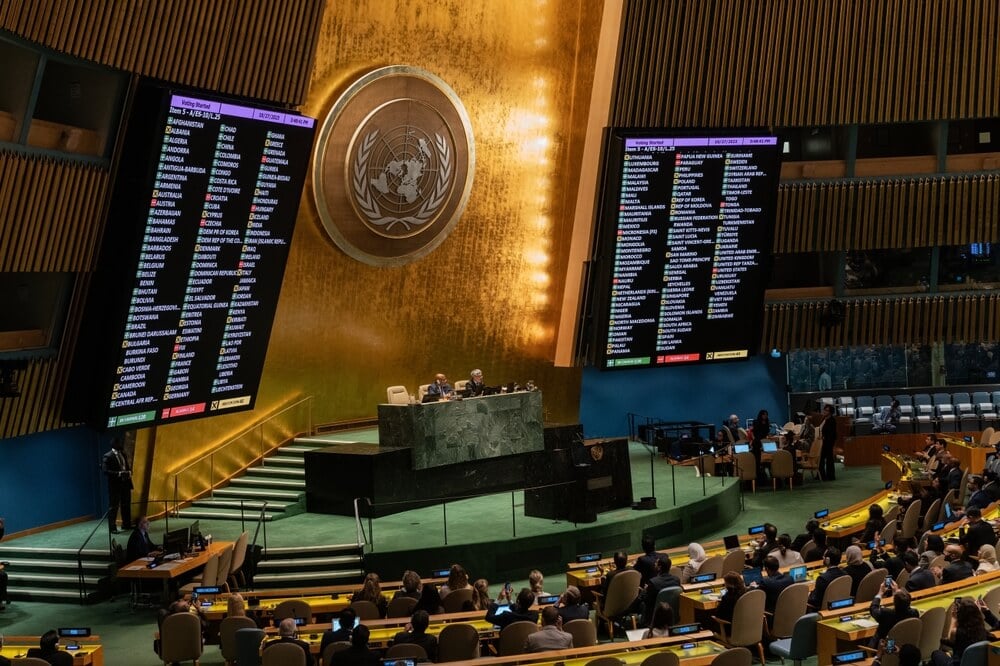 In the UN middle powers can come together and act through the General Assembly, bypassing the Security Council
The world’s middle powers could work to strengthen the many trans-governmental networks that have emerged in recent decades – from the Financial Stability Board to the International Network for Environmental Compliance and Enforcement.
Of course, to do so, they will most likely need to work around the United States and other members who will not play by the rules.
The G7 offers yet another model. It started when France and Germany invited the United Kingdom, Italy, the United States, and Japan to an informal summit in the summer of 1975.
Canada joined the next year, as well as the European Community. Russia formally joined in 1997, creating the G8, which became the G7 again after Russia’s invasion and occupation of Crimea. By the late 2000s, the G7 was also meeting in various formations with other countries, and those groupings evolved into the G20.
In the current context, Carney could invite France, the UK, Germany, Italy, Japan, and the EU to meet with South Korea, Australia, Brazil, Nigeria, South Africa, Mexico, Indonesia, and a few other countries in Ottawa, forming the core of a new M20 (middle powers).
This group could then expand to include others in a middle-power coalition of the willing, which would vote as a reform bloc within other institutions.
The first step would be to require members to commit to the principles outlined above. It is time to turn speeches into political will.
Anne-Marie Slaughter, a former director of policy planning in the US State Department, is CEO of the think tank New America, and Professor Emerita of Politics and International Affairs at Princeton University.
