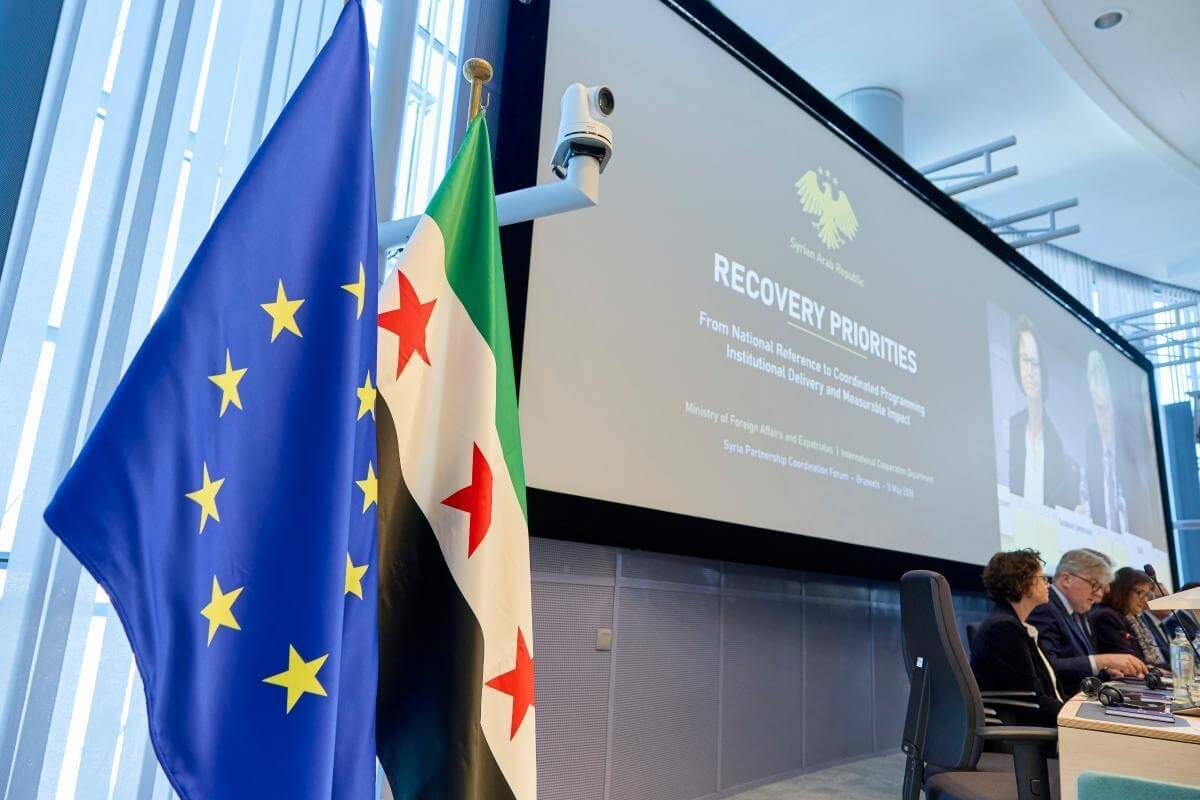
At a Syrian reconstruction forum in Damascus on 17 November, Syrian Foreign Minister Asaad Hassan al-Shaibani said that Syria and the European Union were discussing the scope of the new agreement.
A day earlier, after a meeting of EU foreign affairs ministers, Kaja Kallas announced that Brussels would prepare the agreement concluded in 2008, during the era of Bashar al-Assad, for signature and, at the same time, ask the member states for approval to negotiate a new agreement to replace it.
If both sides approve the provisional application of the 2008 agreement, certain customs privileges and rules for parts of public procurement could come into effect while negotiations on a new agreement are still ongoing.
EU foreign ministers backed preparations to sign the agreement. They are calling on the Syrian authorities to do more to protect human rights, ensure respect for the law, and involve different communities in deciding the country’s future constitutional arrangements.
They did not say when the deal could be signed or what Damascus would have to do before the trade privileges take effect.
The EU can prepare the agreement for signature and separately agree with Syria on the conditions for starting implementation.
Once companies on both sides begin doing business on the basis of lower tariffs and new public procurement rules, it will be harder for European governments to withdraw those benefits.
European companies have a reason to seek rapid implementation
Syria still exports a large share of its industrial goods to the EU duty-free, under a cooperation agreement signed in 1977. After the fall of the Assad regime, the EU lifted economic sanctions on Syria on 28 May 2025, while maintaining measures introduced for security reasons and sanctions against Assad and his associates.
In May 2026, the Council of the EU decided to restore the full implementation of the 1977 agreement. This lifted the partial suspension imposed in response to repression by the Assad regime, which covered trade in oil, oil derivatives and precious metals.
If the implementation of the 2008 text begins, Syrian and European companies will receive additional trade privileges.
The 2008 agreement would have expanded agricultural trade preferences, and Syria would have phased out tariffs on industrial goods from the EU. It would have made it easier for European manufacturers to sell the equipment needed to rebuild the country.
In tenders covered by the agreement, Syrian institutions would have been required to treat European bidders in the same way as domestic ones, and institutions in the EU would have had the same obligation towards Syrian firms.
For contracts awarded under a special procedure of an international organisation, the rules of that organisation would apply.
Before approving the start of implementation, European ministers can ask Damascus to make concrete commitments
The World Bank, for example, already has its own procurement plan for the reconstruction of Syrian transmission lines and substations, for which it approved $146 million in grants in June 2025.
For the trade provisions to take effect before the full agreement enters into force, the EU Council must approve their provisional application. The EU and Syria should then inform each other once they have completed the necessary procedures.
Under Article 143, the new trade rules would take effect on the first day of the third month following whichever of those two notifications was issued later. The deadlines for the gradual abolition of customs duties would also be calculated from that day.
On the same day, the obligation to respect democratic principles and basic human rights would take effect. If one party considers that the other is violating the agreement, it may respond with measures that interfere with its implementation as little as possible.
Before approving the start of implementation, European ministers can ask Damascus to make concrete commitments. They can set out what the Syrian authorities must do, by when, and what data they must provide so that the EU can verify progress.
Damascus is already negotiating reconstruction without Brussels
On 4 November, the Syrian Ministry of Finance signed six contracts with the Saudi Development Fund for soft loans with a total value of more than $403 million. Of this, $90 million is earmarked for renovating the production units of the thermal power plant in Aleppo.
In May 2025, Saudi Arabia and Qatar settled $15.5 million of Syrian obligations owed to the International Development Association, which is part of the World Bank. Syria thus regained the right to request funds from that institution under the same conditions as other borrowers.
The European Investment Bank is also in talks with the Syrian authorities. On 12 November, the Ministry of Transport presented a road reconstruction programme worth approximately $670 million.
This is a financing proposal, whereas a Saudi loan agreement has already been signed for work on the power plant in Aleppo.
Negotiations with the EU on a trade deal are not delaying the Saudi loan, and Damascus no longer needs to meet European demands to begin major reconstruction work.
Some EU member states want Damascus to withdraw the recognition that the Assad regime granted to territories of Ukraine and Georgia under Russian occupation
The European Union has more to offer than loans. Trade with Syria amounted to €556 million in 2025, down from more than €7 billion in 2010.
For Syrian producers, access to such a market can help them reach customers again, provided they have electricity to operate and roads to transport their goods. The World Bank has estimated the cost of rebuilding and infrastructure at around $216 billion.
In January, the EU announced about €620 million in support for 2026 and 2027, including humanitarian aid. Al-Shaibani cited European support for the reconstruction of the al-Rastan hospital as an example of cooperation already under way.
Brussels can continue to help rebuild such institutions while deciding how quickly to expand trade relations. The forum in Damascus brings together donors and the Syrian authorities to agree on the most urgent tasks. Each financier still approves money for specific projects separately.
Some EU member states want Damascus to withdraw the recognition that the Assad regime granted to territories of Ukraine and Georgia under Russian occupation. Kaja Kallas said they raised the issue while discussing what the EU should seek in negotiations on a new deal with Syria.
Preparations for signing the 2008 text are being conducted separately for now, so Damascus can discuss trade privileges with Brussels without first changing its position on those territories.
The Suwayda trials may be the first test
Violence in the southern Syrian province of Suwayda in July 2025 killed more than 1,700 people, mostly members of the Druze religious community, according to an independent UN commission.
Two months later, the Syrian authorities, in agreement with Jordan and the US, pledged to initiate proceedings against anyone for whom there was sufficient evidence of involvement in the violence.
The first public hearing took place on 1 July 2026. In September, the UN commission warned that only a small number of proceedings had been opened and that the issue of commanders’ responsibility remained unresolved.
Before granting trade privileges, the EU can require the Syrian authorities to disclose which cases the prosecutor’s office has investigated, whether it has brought charges and whether the investigation includes those who issued the orders.
 European ministers believe that rebuilding Syria can facilitate the safe return of refugees who wish to go back of their own accord
The families of the victims would thus be able to find out what the prosecutor’s office has done, and Brussels could check how Damascus honours the obligation it has already assumed.
For projects financed from their own budgets, European governments may require that the terms of the tender and the reasons for choosing a particular contractor be made public.
In this way, Syrian companies would know in advance the conditions under which they can compete, and residents would be able to find out who is entrusted with reconstructing their hospitals or water supplies.
Brussels can link those requirements to new investment, while food and medical aid would continue regardless of how quickly negotiations progress.
European ministers believe that rebuilding Syria can facilitate the safe return of refugees who wish to go back of their own accord.
The text of the 2008 agreement specifically regulates the return of Syrian citizens who do not have a right of residence in an EU member state.
At the request of that state, Syria would be obliged to receive them after an identity check. That commitment would take effect only when the entire agreement enters into force, on the first day of the second month after both the EU and Syria officially confirm that they have completed the approval procedures.
European governments are counting on Syria’s reconstruction to facilitate the return of refugees. For people considering going back, the proceedings in Suwayda may indicate whether Syrian institutions are willing to investigate the actions of members of their own forces. Europe expects these same institutions to protect those who return.
If Brussels accepts that, in Suwayda, responsibility ends with the immediate perpetrators, it will have little basis for telling Syrian families that they can count on the protection of the state at home.
