Bosnia needs a political reboot. More than three decades after the Dayton Accords ended the devastating 1992-95 war, it is high time that the country bear full responsibility for its own future.
As part of the 1995 settlement, an international High Representative for Bosnia and Herzegovina was established to help coordinate and implement all the civilian and political provisions of the peace agreement.
A massive NATO force would remain responsible for separating the military forces, but it was agreed that an independent political office was needed to bring the country back together.
That task fell initially to me as the first in a series of high representatives. My immediate priority was to set up the office and get the country’s institutions working, as outlined in the new constitution that had been agreed in Dayton. So, that is what I did.
But the high representative was never supposed to be a permanent institution with powers to intervene directly in the country’s governance.
Had any participant in the Dayton talks dared to propose such a thing, the idea would have been summarily rejected (I know, because I was there).
Dubious legality
After a couple of years, though, the countries overseeing the peace agreement’s implementation decided to give the high representative the prerogative to intervene directly in Bosnia’s affairs, and these so-called Bonn powers have been used extensively ever since.
Their legality was always dubious, at best, but as long as the new arrangement seemed to work, everyone accepted it.
There were indeed critical moments when the high representative stepped in to break a political logjam and allow the country to move forward.
Over time, however, the Bonn powers degraded the country’s political system. Instead of sitting down, working through difficult issues, and hashing out the complicated compromises that governing such a diverse country requires, Bosnian leaders increasingly resorted to calling for intervention by the high representative.
Too many politicians shirked their responsibility and focused their energy on ginning up divisive nationalist sentiment
Too many politicians shirked their responsibility and focused their energy on ginning up divisive nationalist sentiment.
These dynamics then created a vicious cycle whereby outside intervention prevented the system from developing the capacity to deliver on its own, which in turn created demand for renewed intervention.
Since 2008, at the latest, it has been widely recognized that this cannot continue. And yet it has, because inertia came easier to all those involved, and because any radical change did not seem worth the associated risks.
Future with no high representative
Then came the United States’ decision last month to unseat the current high representative.
The reasons for the sudden move remain obscure, but the motive appears to be related to cronyism: An obscure company that is vying for control of future gas pipelines and gas supplies in the region just so happens to have personal ties to circles around President Donald Trump.
To be sure, US authorities claim that removing the high representative is in keeping with the administration’s opposition to “nation-building.”
That may well be partly true. Yet Trump has made no secret of putting commercial and profit-making opportunities first in his foreign “policy.”
The Trump administration could have used its intervention to push through constitutional amendments that have been on the table for years
In any case, this would have been a good occasion for Bosnia to embrace a future with no high representative.
Moreover, the Trump administration could have used its intervention to push through constitutional amendments that have been on the table for years.
There could have been a roadmap of steps and reforms designed to balance competing interests and alleviate various constituencies’ fears about making the leap to genuine independence.
It would not have been easy, but it would have been possible if everyone had capitalized fully on the moment.
Bosnia and Herzegovina belongs in the EU
It wasn’t to be. Because Bosnia is no longer among the top issues on the global agenda, the countries involved felt no impetus to seize the opportunity in front of them.
Once again, they chose the easy road of appointing yet another high representative. But they have so far failed even to do that.
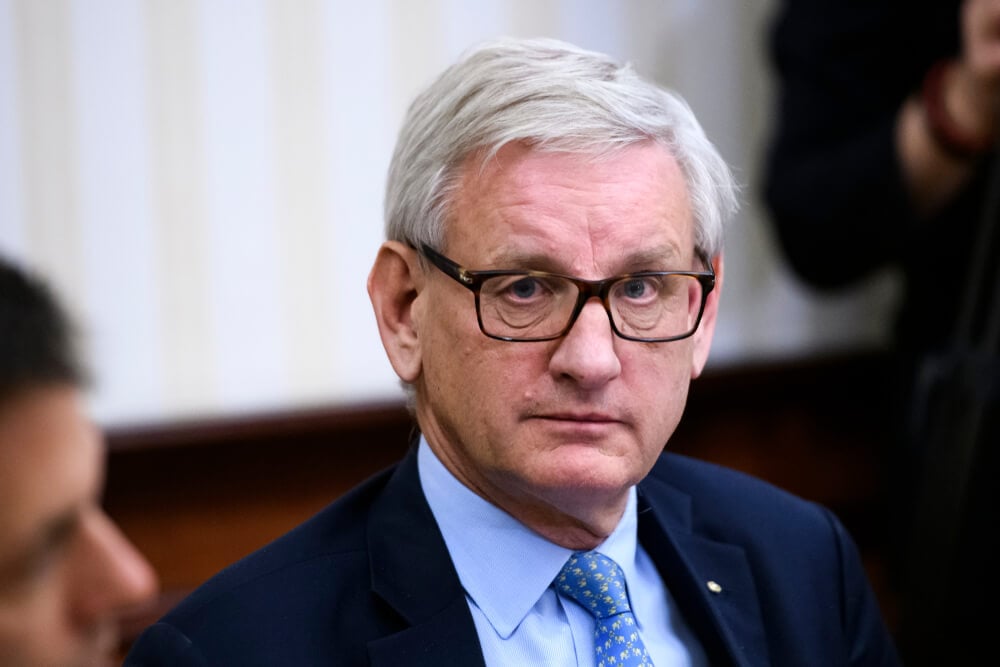 EU accession requires that a country can stand on its own feet and not always rely on some external deus ex machina - Carl Bildt
Under Trump, the US agenda is increasingly out of step with Europe’s priorities, and each is blocking the other’s candidates.
The result—all too familiar nowadays—is an undignified political spectacle devoid of strategy or serious forethought.
Rather than finally addressing the country’s problems, this outcome is sure to prolong them.
Yet the fact remains that Bosnia and Herzegovina—together with its neighbors—belongs in the European Union.
There simply is no other way to secure peace and deliver greater prosperity for the entire region. More than 70% of the country’s inhabitants are clear about this objective.
But EU accession requires that a country can stand on its own feet and not always rely on some external deus ex machina.
The sooner everyone recognizes that, the better. The sordid gamesmanship around picking a new high representative risks further delaying the outcome that everyone operating in good faith should want.
Carl Bildt is a former prime minister and foreign minister of Sweden.
