Research by two economists from the United Nations Conference on Trade and Development (UNCTAD), whose findings the agency highlighted when presenting its annual report on 9 October, shows how little profit from advanced technology remains with those who physically produce it.
In the computer system for artificial intelligence that was analysed, 66.8 per cent of the added value goes to the US company Nvidia, which designs chips and outsources their production.
Taiwan’s TSMC, which manufactures these chips, receives 5 per cent, and the companies that assemble and test the system receive 4 per cent.
Governments around the world pay for chip factories and assembly plants, while the largest profits go to the owners of the technology.
Building a factory may bring production and jobs, but the distribution of income is determined by who owns the knowledge, controls the product and negotiates with customers.
The development of domestic industry is therefore a more demanding task than attracting investment.
The factory brings jobs; the technology brings the greatest profit
UNCTAD researchers studied Nvidia’s GB200 NVL72, a server cabinet with 72 GPUs and 36 processors that together function as a large computer for training and running artificial intelligence models.
They calculated the value distribution based on the system’s estimated cost of $3.3 million, the value of its components and suppliers’ financial statements.
Memory manufacturers SK Hynix, Samsung and Micron account for 6.7 per cent of the system’s added value.
Value added is the difference between the value of what a firm produces and the cost of parts, materials and services purchased from other firms.
It includes wages, taxes, depreciation of equipment and profit. In the production chain analysed, profit after tax makes up 68 per cent of value added, corporation tax 12.4 per cent, and salaries and other income of employees 14.2 per cent.
Within the employees’ share, the wages of workers directly involved in production account for 4.2 per cent of total value added.
The authors estimated how the value of a single product is distributed according to the location of the headquarters of the companies involved in its production.
A company that develops a successful technology can justify high earnings by the money it has invested and the risk it has taken
This calculation shows how much goes to each company, but additional data is needed to determine the benefit to the country where their factories operate.
TSMC earns high profits thanks to complex chip-manufacturing technologies that are difficult for competitors to replicate.
A factory that only assembles imported parts can export high-value goods while providing mainly wages for its employees and limited business for local suppliers in the country where it operates.
A company that develops a successful technology can justify high earnings by the money it has invested and the risk it has taken.
The country that subsidises the factory also evaluates the long-term benefit to the domestic economy: whether engineers will acquire skills needed for other projects and whether local suppliers will develop products and services that they can sell to other customers.
Such knowledge and jobs may remain even after the main investor departs, whereas the size of the initial investment alone does not indicate whether the country will gain them.
Intel walked away from both the factory and Germany’s billions
In June 2023, Germany was ready to grant Intel, the US chipmaker, €9.9 billion for a project in Magdeburg worth more than €30 billion.
The support depended on approval by the European Commission. Intel postponed the project to 2024 and, on 24 July 2025, announced that it was abandoning its planned investments in Germany and Poland.
Four days later, the federal government confirmed that the funds had not been paid out.
The budget avoided spending the promised billions, but the prospect of about 3,000 permanent jobs, which the government and the city had counted on for years, vanished.
The money remained in the budget because payment was conditional on approval by the Commission and the start of construction.
Rich countries have an advantage in the race to attract new plants. According to UNCTAD, developed economies accounted for approximately 70 per cent of the value of announced new projects in high-value strategic sectors between 2020 and 2025, including semiconductors, energy-transition technologies and artificial intelligence infrastructure.
How much of this will actually be built depends on corporate decisions, as in Magdeburg.
OECD recorded $108 billion in subsidies in 2024 across 525 large industrial groups in 15 sectors
The Organisation for Economic Co-operation and Development (OECD) recorded $108 billion in subsidies in 2024 across 525 large industrial groups in 15 sectors.
Relative to income, state support reached its highest level since the 2008–09 financial crisis.
From 2005 to 2024, Chinese firms received on average three to eight times more support relative to income than firms in OECD economies, depending on the comparison group.
A separate OECD study found that subsidies increase the market share of the companies that receive them without raising their investment or efficiency and, with certain forms of state aid, even reduce both.
The authors cite lower prices and the deterrence of competitors from making new investments as possible explanations. Alongside subsidies, rich countries also offer well-developed universities, a reliable energy grid and access to large customers.
A country with a smaller budget that tries to compensate for these differences with even more aid is paying investors to accept weaker business conditions, instead of investing in conditions that could be used by other companies.
Washington changed the terms after the deal
In 2023, the US chip manufacturing support programme CHIPS stipulated that companies receiving more than $150 million in direct aid would return part of their earnings to the state if the project generated significantly more profit than forecast when they applied for the subsidy.
The contract for each project specified when that obligation would begin and how much the state would receive.
The Department of Commerce could exempt an individual project from profit-sharing in exceptional circumstances, but the rules did not specify which circumstances would justify such a decision.
The money raised in this way was intended to provide further support for the US chip industry.
On 22 August 2025, the Donald Trump administration negotiated a revised arrangement with Intel.
 State support raises the question of how the government will balance the interests of shareholders with its obligation to apply the rules impartially across the entire industry
In return for approximately 9.9 per cent of the shares, it committed to invest $8.9 billion: $5.7 billion in previously approved but unpaid aid and $3.2 billion from the chip production programme for defence purposes.
Payments from the defence programme remained tied to fulfilment of its conditions.
The state accepted an equity stake without a seat on the board of directors and without special management rights.
At the same time, it removed the provisions requiring Intel to repay the aid in certain circumstances and to share the earnings from the previously paid $2.2 billion.
Bloomberg estimated the value of the state’s shares and contractual rights at about $36 billion.
That calculation includes the full number of shares provided for in the agreement, including those that will be transferred to the state only after the corresponding payments to Intel.
The increase in their market value gives the state the opportunity to make a profit on sale, with the risk that the price will fall in the meantime.
The agreement also gives the state a five-year option to buy an additional five per cent of the shares at $20 each if Intel loses majority control of its chip-making division, which also takes orders from other companies.
This condition makes it financially difficult to separate that division from Intel.
The equity stake gives the US government an additional financial incentive to support Intel’s operations.
Its decisions on subsidies, public procurement and its approach to competitors can now affect the value of the assets it owns.
State support thus raises the question of how the government will balance the interests of shareholders with its obligation to apply the rules impartially across the entire industry.
According to a Wall Street Journal, the administration did not at that time plan to seek shares in TSMC or Micron, which were increasing their investments in the US.
TSMC announced a total US investment plan of $165 billion in March 2025, while up to $6.6 billion in direct aid was approved for its Arizona plants in November 2024, with payments tied to project progress.
The change in administration brought different demands: Intel was asked for an equity stake, while larger announced investments by other companies influenced the decision not to make such a request of them.
The subsidy thus became only part of the overall deal, with shares and additional investments negotiated separately.
Dresden has yet to demonstrate how valuable profit-sharing will be
ESMC, a joint venture between TSMC, Bosch, Infineon and NXP, represents a different European answer. TSMC owns 70 per cent, while the other partners hold 10 per cent each.
In August 2024, the Commission approved €5 billion in German state aid for its Dresden factory, aimed at the automotive and other manufacturing sectors, where a shortage of a single cheap chip can halt production of far more expensive finished goods.
The plant will also take orders from outside the consortium, with dedicated access for smaller companies and European universities.
ESMC has accepted that, under EU rules, priority orders will be given during a crisis and has agreed to share any profit above expectations with the German state.
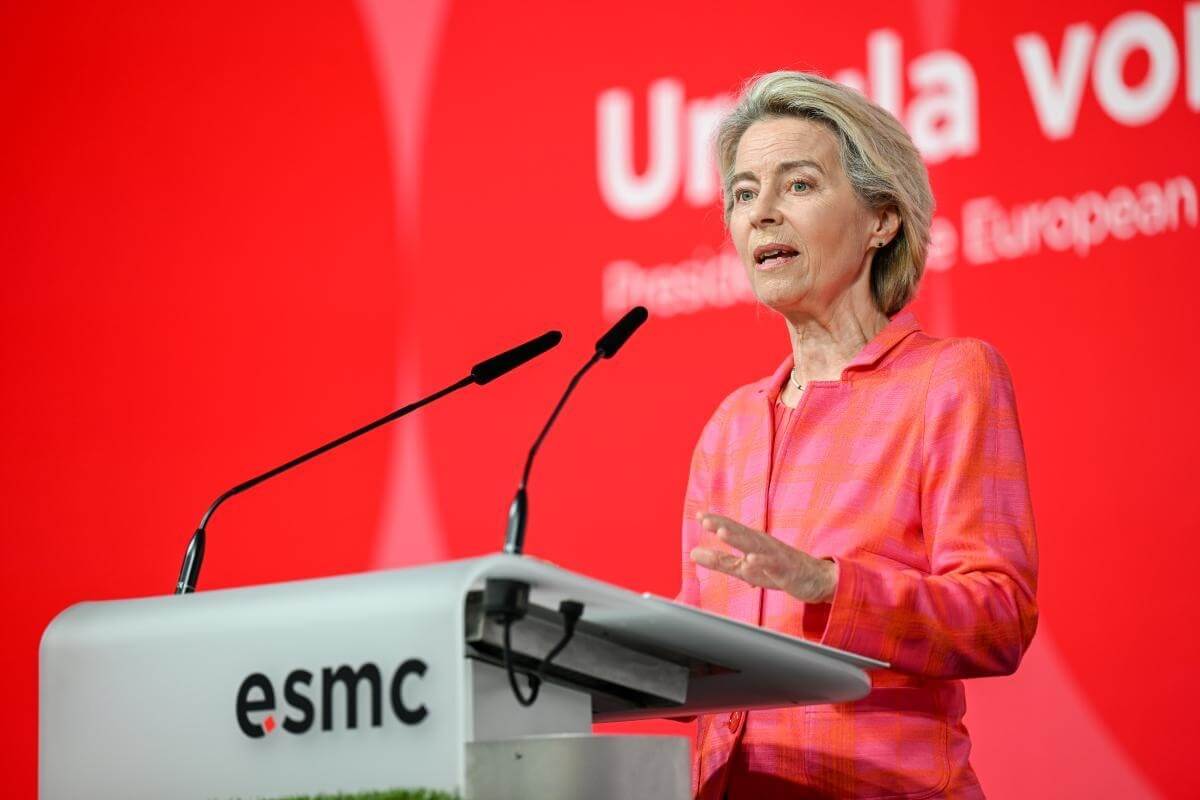 ESMC has accepted that, under EU rules, priority orders will be given during a crisis and has agreed to share any profit above expectations with the German state
However, the Commission’s statement does not specify the threshold at which profit is shared or the proportion that belongs to the state, so the public cannot assess the financial terms of the agreement.
The Dresden factory will produce chips using 28-nanometre down to 12-nanometre technology, which is used in cars and industrial machinery.
TSMC is keeping its most advanced operations in Taiwan, whose government announced a rule in 2025 that the company’s overseas plants must use technology at least one generation behind its domestic facilities.
For €5 billion, Europe secures a reliable source of the chips it needs, while the know-how that brings TSMC the greatest profit remains in Taiwan.
The government of Saxony states that the installation of the first production equipment is planned for 2027, and the Commission expects full capacity to be reached by 2029, producing 480,000 silicon wafers a year.
For European industry, the availability of that output can justify substantial state support even with a modest direct return to the budget, because the calculation also factors in the losses that would result from factory shutdowns elsewhere.
Three cases over the past three years have unfolded in three distinct ways.
Germany avoided the cost because Intel never received the first payment, Washington profited as a shareholder in the company it subsidised, and Dresden will demonstrate, from 2029 onwards, the true value of a profit-sharing mechanism whose terms remain secret.
None of these models alters the distribution outlined at the outset. The companies designing the most sought-after AI chips will retain the lion’s share of profits for as long as their proprietary technology dictates what new factories produce and to whom they sell.
