The UK imposed sanctions on Vostok Oil, a subsidiary of the Russian state oil giant Rosneft, which is developing the largest new oil project in the Russian Arctic.
The project includes oilfields in Siberia, an oil pipeline, and the new port of Bukhta Sever on the coast of the Kara Sea, part of the Arctic Ocean, from which Rosneft began exporting oil in September.
UK Prime Minister Andy Burnham presented the measures in Dublin on the day of the European Political Community summit, which brings together leaders from almost all European countries.
He said that progress in peace talks on Ukraine is no reason to reduce pressure on the revenues Moscow uses to finance the war.
The package also includes Slavneft, jointly controlled by Rosneft and Gazprom Neft, the oil branch of the state gas concern Gazprom.
According to the UK government, this makes the UK the first country to sanction all 10 of Russia’s largest oil producers. The sanctions were introduced at a time when Rosneft has yet to prove that it can use the new port during the winter.
The first cargo was loaded on 6 September at Bukhta Sever. The US sanctioned Vostok Oil in January 2025, and the UK added the tanker Valentin Pikul to its sanctions list in September, followed by Rosneft in October.
Part of the first cargo was taken to Murmansk, Russia’s largest Arctic port, where it was transferred to other ships.
One tanker headed straight for Asia via the Northern Sea Route, which runs along Russia’s Arctic coast to the Bering Strait. London is now trying to make it harder to expand operations that have already begun despite earlier sanctions.
A port that is difficult for Ukrainian drones to reach
The 790-kilometre oil pipeline brings oil from two fields in Krasnoyarsk Territory to Bukhta Sever. The first is Vankor, which has produced oil since 2009 and currently supplies most of the oil exported through the new port. The second is Payakha, where Rosneft is still developing production and expects most new volumes to originate.
Oil traders estimate that the project will export an average of 150,000 barrels per day this year. Rosneft plans to quadruple exports to 600,000 barrels per day by the second half of 2027 and to reach 1 million barrels per day by 2030.
Even the first target would represent approximately 7 per cent of total Russian crude oil production in October, which, according to estimates by the OPEC, amounted to 8.67 million barrels per day.
Traffic at the new port may grow even if Russia does not extract more oil overall
At this stage, the project is most valuable to Moscow as a new outlet to the sea. Ukrainian drone attacks, damage to the Druzhba pipeline supplying Hungary and Slovakia, and the seizure of tankers in March halted at least 40 per cent of Russia’s oil export capacity, or about 2 million barrels a day.
The Baltic ports of Primorsk and Ust-Luga and the Black Sea port of Novorossiysk were hit hardest. During the summer, attacks continued, particularly on tankers in the Black Sea. Bukhta Sever is thousands of kilometres from those ports and much harder for Ukrainian drones to reach.
Traffic at the new port may grow even if Russia does not extract more oil overall, as part of Vankor’s production that previously entered the state pipeline network now goes to sea via Bukhta Sever.
London shuts the doors Moscow wants to open
UK sanctions against Rosneft already apply to the companies it controls, including Vostok Oil, but naming the company specifically on the sanctions list brings three changes. Banks no longer need to determine whether Vostok Oil is subject to sanctions through Rosneft’s ownership, as the company is now explicitly listed.
Ships owned, controlled or chartered by Vostok Oil can no longer enter UK ports, and technical assistance to those ships, such as maintenance and repairs, is restricted.
Western countries have set a maximum price at which Russian oil can be sold if it is transported by Western shippers or covered by Western insurers.
When the oil is sold below that price, Western firms can provide these services. This exception no longer applies to Vostok Oil, and UK insurers and shippers cannot work for it even if the price falls below the limit.
The decision also carries political implications, as Moscow is counting on the return of Western companies and capital.
London made it clear that UK companies, banks and insurers could not participate in the project until the UK lifted sanctions
At the project’s opening in September, Rosneft director Igor Sechin greeted his colleagues from UK firm BP and US firm ExxonMobil, saying he believed they would be very happy with the launch. BP, which held a 19.75 per cent stake in Rosneft, announced in February 2022, following the invasion of Ukraine, that it was exiting the investment and recorded a loss of up to $25 billion on its books.
Two large international trading houses withdrew from Vostok Oil itself: Trafigura, which sold its 10 per cent stake to the little-known Hong Kong company Nord Axis in July 2022, and Vitol, whose consortium sold its 5 per cent stake to Fossil Trading in the United Arab Emirates in December that year.
Since then, Rosneft has financed the project through domestic funds and asset sales. As US envoys Steve Witkoff and Jared Kushner held talks with Putin in Moscow on 12 November about ending the war, London made it clear that UK companies, banks and insurers could not participate in the project until the UK lifted sanctions.
Winter brings tankers back to European waters
During this year’s Northern Sea Route shipping season, a record 13.2 million barrels of crude oil and oil products were transported from Russian ports to Asia, including the first cargoes of Vostok Oil. At the projected 600,000 barrels per day, Vostok Oil alone would ship an equivalent volume across all export routes in just 22 days.
All 28 ships that transported Russian crude oil on that route to foreign customers in 2025 and 2026 were under sanctions from at least one Western country, and seven of them were not ice-strengthened.
In winter, the eastern part of the route to Asia is mostly closed to tankers, and only ice-strengthened ships, accompanied by icebreakers, can sail through the Kara Sea. Until summer, most of the oil from Bukhta Sever will have to go west to Murmansk, where it will be loaded onto conventional tankers.
These tankers continue along the coasts of Norway and the UK towards the Mediterranean Sea and the Suez Canal. They pass through waters where European countries are increasingly stopping ships belonging to the so-called shadow fleet – old tankers with unclear ownership and dubious insurance that Moscow uses to circumvent sanctions.
Each delay means more expensive, specialised ships are needed to move the same monthly volume
In April, the European Union added the port of Murmansk to its sanctions list, banning European companies from doing business with it.
In January, the French navy intercepted the tanker Grinch, which had sailed from Murmansk, off the Spanish coast in the Mediterranean. At the end of May, with the help of the UK navy, it intercepted the tanker Tagor, which had also sailed from Murmansk, in the Atlantic.
According to calculations from March, the seizure of tankers in Europe disrupted exports from Murmansk by about 300,000 barrels per day.
Transhipment in Murmansk allows Rosneft to use ice-strengthened ships only on the short Arctic leg of the journey and to return them more quickly to Bukhta Sever for new cargoes.
How many times a ship can make that round trip during winter depends on the ice and on how long the tankers must wait for one another at the loading point.
Each delay means more expensive, specialised ships are needed to move the same monthly volume. If the ships do not arrive quickly enough, the oil arriving by pipeline has to wait in storage tanks.
When the tanks are full, Rosneft has to reduce the flow of oil from the fields. Direct sailings to East Asia are shorter than the route via the Suez Canal and bypass European waters, but are only possible for a few months a year.
High prices cover an expensive route
From February 2023 to the end of October 2026, China bought about half of Russian crude oil sold abroad, and India bought 37 per cent. In September, Indian and Chinese refineries competed for limited quantities of Russian oil.
The war with Iran and disruptions to navigation through the Strait of Hormuz, which handles a large share of Persian Gulf oil exports, pushed the average price of Brent crude, the main global benchmark, to almost $124 per barrel in October.
Russia’s average daily revenue from crude oil exports rose by 19 per cent in October compared with September, even though export volumes increased by only 6 per cent.
At such prices, Rosneft’s cargoes from Bukhta Sever are profitable despite higher transport, transhipment and insurance costs. If prices fall and buyers can easily find oil elsewhere, refineries will demand a discount for unreliable Arctic supplies or turn to other suppliers instead.
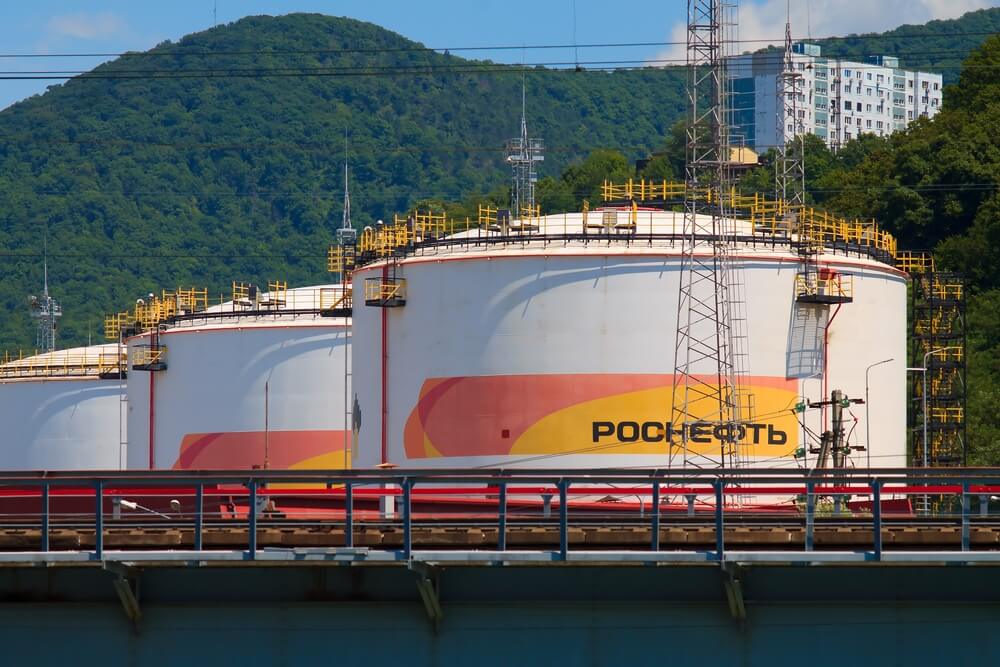 Rosneft is unlikely to reach the target of 600,000 barrels per day in the second half of 2027
Until spring 2027, deliveries from Bukhta Sever will remain irregular, and most oil will be shipped via Murmansk and through European waters.
Rosneft is unlikely to reach the target of 600,000 barrels per day in the second half of 2027, as it would need to significantly increase production at Payakha and secure enough ice-strengthened ships for regular winter sailings, of which there are currently very few.
However, Moscow is already getting what it needs most: an export port that Ukrainian drones struggle to reach, at a time when high oil prices offset higher transport costs.
The UK decision alone will not directly stop any tankers, but it has struck the project at its weakest point.
In winter, oil from Bukhta Sever, cut off by ice from the eastern part of the route, will have to pass through the North Sea and the English Channel, alongside UK and French ships that have already helped to stop tankers from Murmansk this year.
Russian exports, sheltered from Ukrainian drones in the Arctic during winter, are back under the supervision of European navies.
