The UK government is to decide in the coming weeks whether to give the green light for oil production from Britain’s largest undeveloped field, after the collapse of the COP31 talks underlined the fragility of the international climate consensus.
Environmental lobbyists say the UK has an opportunity to further reinforce its climate credentials by refusing permission for the offshore Rosebank project, having adopted a tough stance at this month’s failed Antalya summit.
They and their political supporters are nevertheless up against self-styled pragmatists who are inclined to back domestic fossil fuel production that would boost the UK’s economy without transgressing its climate change commitments.
With a decision on Rosebank still pending, gas has already begun flowing from the Jackdaw field off the coast of Scotland after the government last month gave the go-ahead for another stalled project.
While gas from Jackdaw will flow directly into the UK to supply its homes and businesses, oil from Rosebank would feed into an international market at global prices inflated by this year’s supply disruptions.
The vulnerability of supply lines from the Middle East, exposed by the US-Iran conflict, has focused attention on energy security, a key element in the argument of the pragmatists.
Both the Jackdaw and Rosebank projects were approved by previous Conservative governments but were stalled by legal rulings that required a more comprehensive assessment of their environmental impact.
The final say on Rosebank
The final say on Rosebank will come from the Labour government’s energy secretary, Miatta Fahnbulleh, who issued last month’s go-ahead for gas production from Jackdaw.
She said at the time that production from the field would boost the UK’s gas supplies this winter and support jobs and energy security over the longer term.
She cautioned, however, that Rosebank, 80 miles to the north-west of Shetland, was a “different proposition” as its oil would mainly be exported.
Fahnbullah has since argued that greenlighting the oilfield would not bring down household energy bills, a basic benefit required to reinforce narrow public support for further domestic fossil fuel production.
The letter warns that the wrong decision would destroy the UK’s credibility as a global climate leader
As she prepares to deliver her quasi-judicial judgment before the end of the year, fellow ministers and Labour MPs are widely reported to be divided on an issue that could provoke a rebellion in Prime Minister Andy Burnham’s ruling party.
The Times reported that more than 75 Labour MPs had signed a draft letter opposing approval for Rosebank, also maintaining it would not reduce energy bills.
The letter, which will be addressed to Burnham and Treasury minister John Healey, warns that the wrong decision would destroy the UK’s credibility as a global climate leader.
A “pragmatic approach”
Burnham has described himself as an energy pragmatist, although he has not directly taken sides in the Rosebank debate. He reaffirmed his previous support for a “pragmatic approach” to North Sea oil and gas shortly after Jackdaw was approved.
“We’re committed to moving towards renewable energy and reaching net zero by 2050,” he said. “But even on our ambitious climate path, we’ll still require oil and gas as part of our energy needs for decades to come.”
On the face of it, fulfilling those hopefully diminishing requirements from local sources rather than shipping them half way round the world sounds eminently sensible. From a pragmatic perspective, blocking such resources might be little more than virtue-signalling.
The counter argument from climate campaigners is that it is perverse for countries such as the UK to lecture others about curbing fossil fuel output at the same time as adding to the problem.
The UK prime minister said he was deeply disappointed that no consensus had been reached at Antalya
At COP31, where Burnham was the only major national leader to attend, however briefly, the UK, European Union and others baulked at agreeing to a deal from which oil producers sought to excise all mention of fossil fuels.
The UK prime minister said he was deeply disappointed that no consensus had been reached at Antalya. He said the deal on the table risked going backwards on climate change, which was why the UK could not support it.
How much more hollow his words might have sounded had his government already given the nod to its own oil output expansion via Rosebank.
The climate activists might argue that they are the true pragmatists, focused on maintaining a fraying consensus on combatting the existential threat of global warming rather than allowing short-term fixes that offer limited benefits.
Burnham’s first major challenge
Rosebank is estimated to hold the equivalent of around 300 million barrels of oil and could reach peak production of 69,000 barrels a day. Most would be shipped to Europe for refining and subsequent sale on the open market.
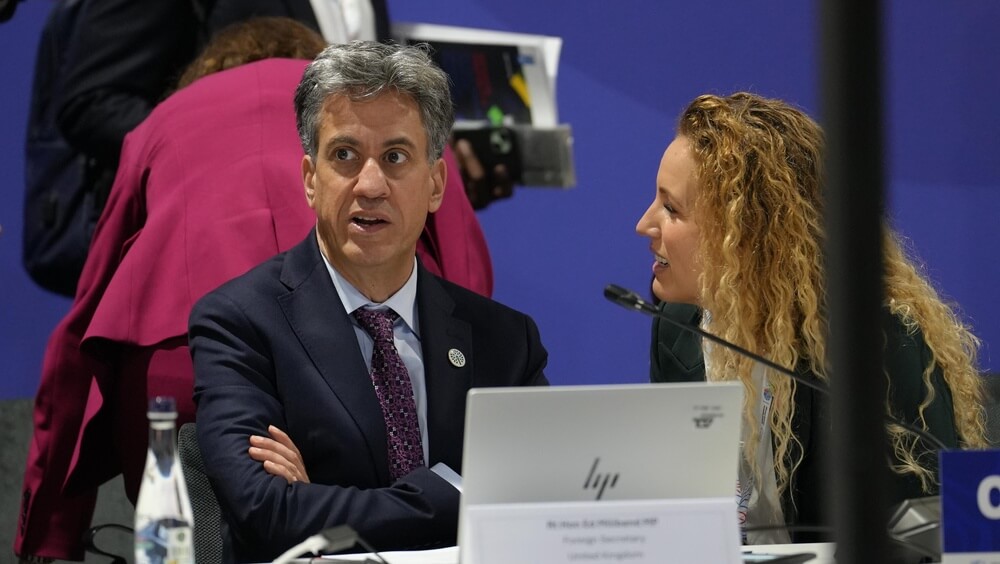 Ed Miliband has said he would not resign if Rosebank received the go-ahead
Its developer, Adura, has estimated that the field would generate about 250 million tonnes of greenhouse gases over its lifetime, which would otherwise be generated by output from other fossil fuel sources.
The Treasury’s Healey is believed to back the project and his department is already banking on the potential tax receipts it offers.
His cabinet colleague, foreign secretary Ed Miliband, who previously described the project as a colossal waste of taxpayer money and “climate vandalism” when he was energy secretary, has said he would not resign if Rosebank received the go-ahead.
Any cabinet split on the issue would present Burnham with his first major challenge since he took office in July and embarked on a controversial plan to redraw the UK’s post-Brexit relationship with Europe.
He is soon due to set out his 10-year plan for the country’s future. If climate gets a mention, he has an opportunity to confirm that no such reset is planned when it comes to the UK’s commitment to fighting global warming.
