Iran is still holding out against the United States. Its officials are even talking of moving from defence to attack in order to break the American naval blockade in the Arabian Sea, which has prevented Iranian oil exports for more than four months
By Iran’s own admission, however, the blockade is inflicting serious economic damage, leaving both households and state institutions struggling to meet basic needs.
President Masoud Pezeshkian has been the most prominent figure in the regime to acknowledge the scale of the problems, with others in the leadership tending to play them down.
He has called for a negotiated settlement with Washington that preserves Iran’s ‘dignity’ and ends a conflict now approaching its tenth month.
The president under pressure
Pezeshkian’s public stance is colliding with the regime’s hardline faction, led by the Revolutionary Guards and backed by the speaker of parliament, Mohammad Bagher Ghalibaf, himself a former Guards commander who lost to Pezeshkian in the 2024 presidential election.
Pezeshkian and his government are increasingly bearing the brunt of public anger over falling living standards and deteriorating public services, particularly electricity supplies.
In parliament, a member of the praesidium ridiculed Pezeshkian’s decision to work in an unheated, unlit office, sarcastically urging him to turn on the lights so that he could read reports and sign documents properly.
Meanwhile, Revolutionary Guards commanders and their hardline allies stand to benefit politically from escalating tensions, without facing the same degree of public accountability for the economic consequences.
During a meeting with academics and students at Ferdowsi University in Mashhad on 25 November, Pezeshkian faced harsh criticism – enough to anger him to the point that he walked out of the room.
Pezeshkian’s public frustration reveals a deeper struggle over political authority and the power to decide on war and peace
A day earlier, addressing political activists in Mashhad, Pezeshkian had said that he had refrained from saying many things for the sake of national unity. In a veiled criticism of elements within the regime, Pezeshkian accused them of obstructing the country’s affairs and undermining its diplomacy.
His government could hit back, he said, but feared deepening internal divisions. He likened his predicament to ‘a thorn in the eye and a bone in the throat’, an expression rooted in Islamic tradition that conveys forbearance in pain.
Pezeshkian has repeatedly insisted that his government has taken no step towards negotiations with Washington without the approval of the supreme leader, Mojtaba Khamenei.
He may have done so to shift some responsibility to a leader who has been shielded from criticism: Khamenei has not been seen or heard in public since succeeding his father, who was killed in an American–Israeli strike on 28 February.
Pezeshkian’s statements seem to have done little to deflect criticism. His supporters are calling for an end to the current state of ‘neither war nor peace’. The hardline newspaper Kayhan has labelled them ‘surrender merchants’ and accused them of trying to shift blame onto opponents of Pezeshkian’s diplomatic approach.
Pezeshkian’s public frustration reveals a deeper struggle over political authority and the power to decide on war and peace.
Who decides on war and peace?
Iran’s reformists have the electoral strength to win the presidency, but wield considerably less influence within unelected security and oversight institutions.
The conservatives, meanwhile, are far from a united bloc. Their ranks include hardliners who reject concessions, some even opposing negotiations altogether, and pragmatists who regard diplomacy as a means of easing pressure on the state.
Having won the 2024 presidential election with nearly 55 per cent of the vote, Pezeshkian considers himself to have both the constitutional authority and the popular mandate to help end the war and turn what the regime regards as a military victory into a political one.
The ascent of hardliners to senior positions has increasingly sidelined Pezeshkian and his moderate allies
The president chairs the Supreme National Security Council, which shapes the country’s military and security policies, including matters of war and peace. Its decisions, however, require the supreme leader’s approval. Its secretary, Mohsen Rezaei, also serves as Mojtaba Khamenei’s representative on the council.
With real power in the hands of the supreme leader and Guards veterans such as Mohsen Rezaei, the presidency is confined to the mundane business of governing: keeping the lights on, meeting people’s basic needs, absorbing the fallout of war and, of course, taking the blame.
The ascent of hardliners to senior positions following the killing of much of the military leadership, coupled with the succession of a supreme leader drawn from the Revolutionary Guards’ own circles, has increasingly sidelined Pezeshkian and his moderate allies.
Rezaei: The general at the centre of power
Until recently, Mohsen Rezaei was a retired general with a string of failed presidential bids behind him. His appointment in August to the security council brought him back to the centre of Iranian power.
At just 27, he took command of the Revolutionary Guards in 1981, a year into the war with Iraq. During his 16 years in command, many of today’s senior Guards commanders rose through the ranks under his leadership.
He subsequently spent nearly 24 years as secretary of the Expediency Discernment Council, consolidating his political influence.
His military seniority and deep roots in the Guards’ institutional structure and political thinking underpin his influence within the regime, now reinforced by his authority to speak in the name of the absent supreme leader.
The absent arbiter
Under the doctrine of Velayat-e Faqih (Guardianship of the Islamic Jurist), the supreme leader combines religious and political authority, giving his directives considerable legal and political force.
This concentration of authority enabled Ali Khamenei to arbitrate power struggles within the regime, brutally suppress successive waves of popular protest and contain reformist movements, removing or marginalising their leading figures.
Rezaei, Ghalibaf and Pezeshkian each invoke the supreme leader’s authority
That authority has diminished sharply since Ali Khamenei’s death. His son’s prolonged absence from public life, ostensibly for security reasons, has prevented him from filling the political vacuum left by his father.
Rezaei, Ghalibaf and Pezeshkian each invoke the supreme leader’s authority, legitimising their own positions and strengthening their hand against their rivals by claiming to act on his direct instructions.
The cost of waiting
The state of ‘neither war nor peace’ gives Iran’s leadership time to manoeuvre politically, rebuild its military capabilities and retain its bargaining chips without risking an immediate return to full-scale confrontation with the United States and Israel.
But for Iran’s population of more than 90 million, the economic cost of waiting continues to mount. According to figures from Iran’s Statistical Centre cited by Reuters, consumer prices rose by 88.7 per cent year on year in October, average annual inflation reached 76.8 per cent, and food and beverage prices surged by 112.6 per cent.
Yet the regime’s factions draw different conclusions from the same economic reality. Pezeshkian makes the case for a settlement to secure financial relief and stability. Ghalibaf makes it conditional on Washington meeting Iran’s demands, while Rezaei adopts a more uncompromising stance.
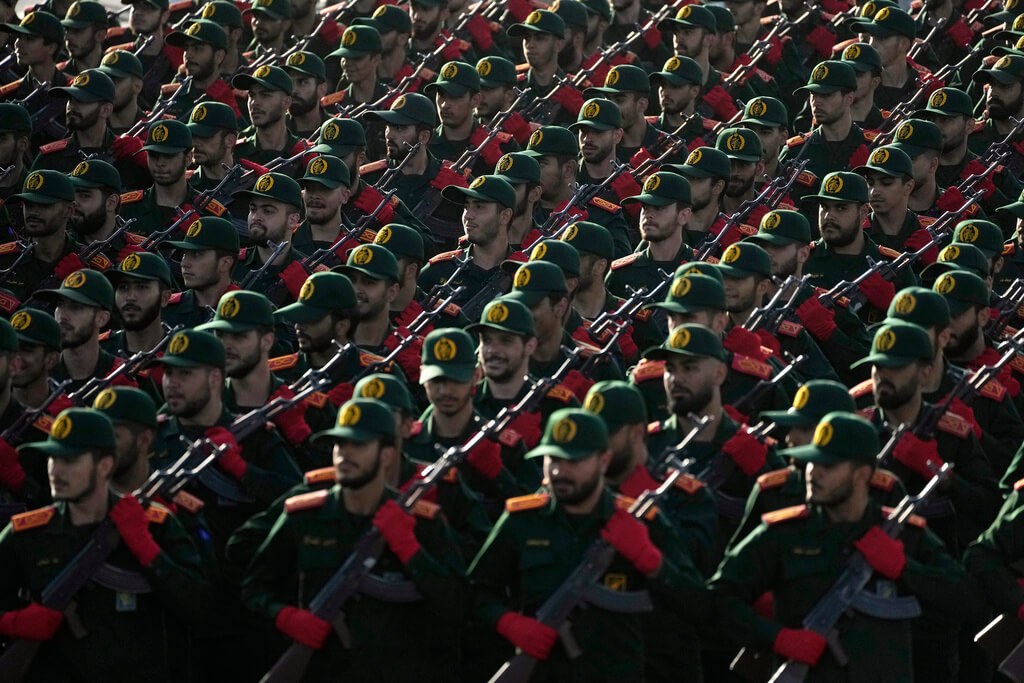 Hardliners believe Tehran retains sufficient firepower to secure better terms through confrontation than at the negotiating table
For reformists, the imbalance in conventional military power makes the pursuit of an optimal settlement through continued confrontation an expensive gamble.
Hardliners, however, believe Tehran retains sufficient firepower to secure better terms through confrontation than at the negotiating table.
A US Congressional Research Service report cites intelligence estimates from May suggesting that Iran retained substantial military capabilities despite the damage inflicted by the war. November also saw a further increase in maritime attacks in and around the Strait of Hormuz.
Washington’s conventional military superiority has not eliminated Tehran’s capacity to disrupt international commerce, as the 40 per cent decline in oil traffic through Hormuz illustrates.
Those favouring confrontation appear to believe that Iran can secure a settlement encompassing sanctions relief, the release of frozen assets, compensation for war damage and Iranian control over the Strait of Hormuz, while preserving its nuclear programme. From their perspective, such an agreement would constitute an outright victory and strengthen Iran’s regional position for years to come.
Iran is therefore caught between those seeking an acceptable agreement to revive the economy, and those risking further escalation – and further economic harm – in pursuit of an ideal one.
When stalemate threatens unity
Each faction defends its approach while shifting responsibility for the stalemate elsewhere.
If the state of ‘neither war nor peace’ persists, the regime’s security establishment may consolidate its power in the name of confronting an external threat, further marginalising advocates of diplomacy.
Alternatively, the gulf between the state and society may widen, while internal disputes over responsibility for the stalemate and over the limits of military escalation intensify.
Pezeshkian’s statements should be understood as an expression of concern about the erosion of unity rather than evidence of an existing fracture
Pezeshkian’s statements should therefore be understood as an expression of concern about the erosion of unity rather than evidence of an existing fracture. His concern appears to extend beyond national unity to the political cohesion of the regime itself.
Unless the present stalemate produces a settlement or a decisive outcome, ‘neither war nor peace’ risks becoming a source of political attrition, eroding trust within the regime and deepening the very divisions the president has chosen to leave unspoken.
Siba Madwar is a Syrian political commentator and PhD researcher at King’s College London, specialising in conflict resolution in divided societies and post-conflict statebuilding.
