Russian diplomat Alexey Drobinin said on 11 November that Moscow could sign non-aggression agreements with certain NATO members. According to him, the countries that accepted them would receive additional Russian security guarantees.
Russia is already obliged under international law to respect other states’ borders, yet its army has been waging a war of aggression against Ukraine for almost five years.
The Kremlin is now trying to present the obligation it violates daily in Ukraine as a new concession to European governments. The value of that offer is best judged against the documents Moscow has already signed and then violated.
Drobinin, director of the foreign policy planning department at the Russian Ministry of Foreign Affairs, spoke at a conference in Moscow about three models of security relations.
The first involves alliances and mutual assistance agreements, such as those Russia has with Belarus and North Korea. The second establishes a political obligation not to assist the other signatory’s adversaries in the event of aggression, as set out in the 2025 Russian agreement with Iran.
Only in the third model, that of mutual non-aggression agreements, did he explicitly refer to individual NATO members. He did not name any country, present a draft, or set out the conditions under which such an agreement might be concluded.
Washington initiated the discussion on a new European security framework in this round of negotiations. On 5 November, US President Donald Trump, after meeting Putin’s envoy Kirill Dmitriev, stated that the future agreement could include “all of Europe”.
On the same day, his envoy Jared Kushner presented a framework that would include permanent security consultations, crisis-communication channels, greater military transparency and mutual de-escalation measures.
He stated that NATO remains the pillar of collective defence and that no country should have the right to veto another’s choice of alliance.
On 11 November, the head of the Russian negotiating delegation, Vladimir Medinsky, said that European security was the central topic of the two-day talks between Russia, Ukraine and the US in Abu Dhabi.
Drobinin’s idea points in a different direction. Instead of a common framework in which NATO acts as a whole, he proposes separate agreements with individual member states. There is no confirmation that such agreements were discussed in Abu Dhabi.
A promise made and broken
The United Nations Charter obliges all members, including Russia, to refrain from threatening or using force against the territorial integrity and political independence of any state.
Moscow reaffirmed these principles in the NATO–Russia Founding Act of May 1997, the document through which the two sides regulated their mutual relations after the Cold War.
At that time, it also affirmed respect for sovereignty, the inviolability of borders and the right of states to determine their own security. The act expressly excludes any right of veto for either party over the decisions of the other.
An even more immediate example is the Budapest Memorandum of December 1994. Under it, Ukraine agreed to give up the nuclear weapons that remained on its territory after the collapse of the Soviet Union.
Russia, the United States and the UK affirmed that they would respect Ukraine’s independence and existing borders, and would refrain from the threat or use of force against it.
The document did not provide for automatic military intervention by the other signatories in the event of an attack, but Russia’s commitment to Ukrainian sovereignty was unequivocal.
A serious agreement would require concrete steps to reduce military risks, effective mechanisms to verify their implementation and clear accountability for any violations
Russia illegally annexed Crimea in 2014 and launched a large-scale invasion in February 2022. Any current Russian proposal on non-aggression must be assessed in the light of those actions. A new signature does not, in itself, restore the trust that Moscow lost by violating earlier agreements.
A serious agreement would require concrete steps to reduce military risks, effective mechanisms to verify their implementation and clear accountability for any violations.
In discussions of European security, Moscow also invokes the principle that no country should strengthen its own security at the expense of another.
The Charter for European Security, adopted in Istanbul in 1999 by members of the Organization for Security and Co-operation in Europe (OSCE), including Russia, contains this principle, but at the same time affirms the right of states to choose and change alliances and rejects spheres of influence.
Russia reaffirmed these principles at the OSCE summit in Astana in 2010. Demanding that a neighbouring country allow Moscow to decide on its defence would be contrary to these principles.
What would stand behind the Russian signature
A simple agreement between two states not to attack each other would not, in itself, be contrary to the North Atlantic Treaty, NATO’s founding document. Article 5 obliges allies to assist a member under armed attack, with each deciding for itself which measures it deems necessary, including the use of military force.
Article 8 prohibits members from assuming international obligations that conflict with that treaty. A legal problem would arise only if, alongside the promise of non-aggression, there were demands that the member state limit the deployment of allied forces on its territory or restrict aid to an ally under attack.
Aid to Ukraine raises a separate question. Since Ukraine is not a member of NATO, Article 5 does not oblige its partners to supply it with weapons.
A European government could make a political commitment to Moscow to reduce that aid without violating any provision of the NATO treaty.
By reaching an agreement with a single capital, Russia could weaken the common European policy towards Ukraine.
If one capital were to secure a separate relationship with Moscow, the others would have to assess how far this relationship would affect joint military plans, sanctions and support for Ukraine
On 11 November, Drobinin did not publicly state such conditions. However, previous Russian demands indicate the kind of concessions Moscow expects.
In December 2021, it published draft agreements with the United States and NATO that aimed to halt NATO expansion, limit the alliance's military presence in Eastern Europe, and bar Ukrainian membership.
This was an attempt to make other countries’ security choices dependent on an agreement with Russia. When those demands were rejected, Russia invaded Ukraine two months later.
In December 2025, Russian Foreign Minister Sergei Lavrov proposed that Russia’s pledge of non-aggression towards NATO and EU member states be turned into a legally binding document, on a collective and mutual basis.
Drobinin now refers to additional guarantees for individual members instead of a joint obligation. If one capital were to secure a separate relationship with Moscow, the others would have to assess how far this relationship would affect joint military plans, sanctions and support for Ukraine.
Europe cannot be the subject of someone else's agreement
On 9 November, the European Union extended the mandate of the mission to train Ukrainian soldiers until 15 November 2028 and allocated almost €300 million, about $335 million, for the next two years.
A day later, representatives of the EU, France, Germany, Italy, the UK, Ukraine, the United States and NATO in Abu Dhabi reaffirmed that future agreements must respect states’ sovereignty and independent decision-making.
Their joint statement also affirmed that NATO remains the pillar of collective defence. Both documents were adopted by joint agreement between several states, and this is precisely the type of decision-making that separate Russian agreements with individual capitals could erode.
During the talks on Ukraine, Russia insisted on a format that excluded all European delegations. Moscow is now offering separate talks, one by one, to the European governments it does not wish to have at the negotiating table.
No capital can independently assume obligations on behalf of other NATO members or unilaterally determine the security of Ukraine
Measures to prevent dangerous military incidents make sense when they are mutual and their implementation can be verified.
Announcing large-scale exercises, sharing information on the deployment of certain weapons and maintaining reliable emergency contact channels between commands could reduce the likelihood of misjudgement.
Such rules would be equally binding on the Russian and allied sides, and would need to be set by the European countries whose defence is at stake.
The summit of the European Political Community, which brings together leaders from almost all of Europe, and the informal meeting of EU leaders in Dublin on 12 and 13 November are an opportunity for European governments to agree on the limits of talks with Moscow.
No capital can independently assume obligations on behalf of other NATO members or unilaterally determine the security of Ukraine, whose defence and future borders would be directly affected by such agreements.
The Kremlin can win even without a signed agreement
Drobinin's offer is unlikely to attract any signatories among NATO members in the coming months. Any government that, relying on a Russian promise, accepted limits on allied defence or aid to Ukraine would provoke a serious dispute with its partners.
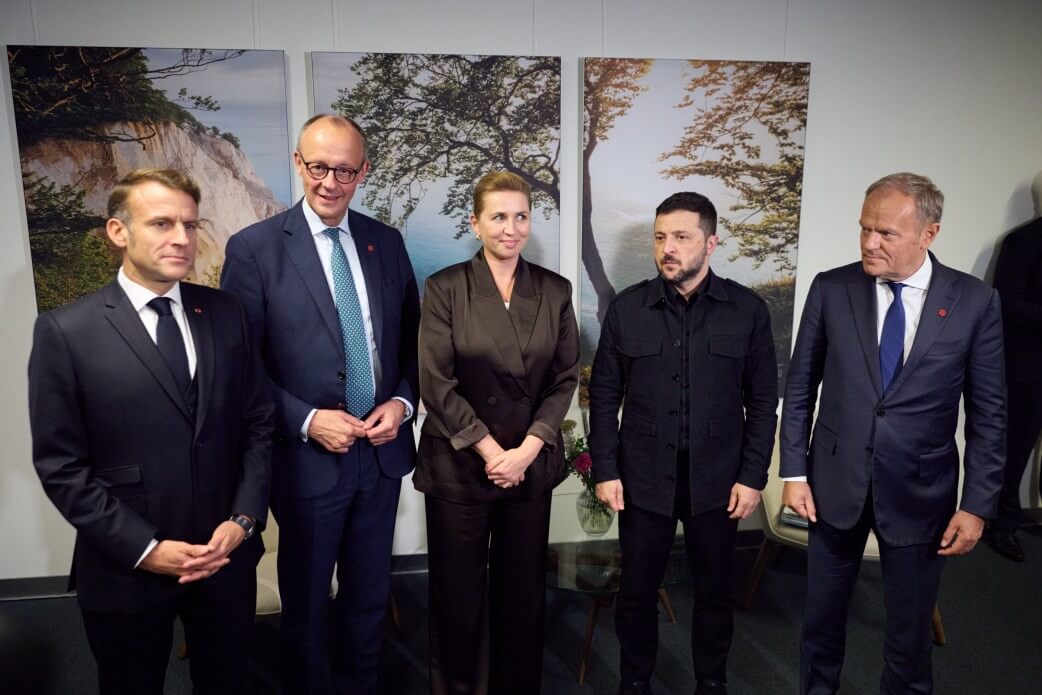 European governments and Kyiv have good reason to refuse to allow a reshaping of the continent's defences to become the price of Russia ending its aggression
Moscow still benefits from the offer even without a signature, because in negotiations with Washington it can reintroduce the demands from December 2021 into the discussion under the label of a new European security order.
Kushner and Trump's special envoy Steve Witkoff arrived in Moscow on 12 November for talks with Putin, and the American readiness to discuss these issues while the war continues is already giving the Kremlin diplomatic room to manoeuvre.
European governments and Kyiv have good reason to refuse to allow a reshaping of the continent's defences to become the price of Russia ending its aggression.
The Russian proposal should be judged on whether Moscow ends its attacks on Ukraine, accepts its independence and agrees to verifiable limits on its own military behaviour. Any NATO member that signed such an agreement in advance would immediately give up part of its freedom of decision.
In return, Russia would offer nothing but yet another promise of the kind it has so far broken whenever it suited. Joint European defence and Ukraine's security must not become the price of a signature that Moscow respects only until it decides it needs war again.
