The admission by the President of the European Commission, Ursula von der Leyen, that Europe’s abandonment of civilian nuclear power was a “strategic mistake” comes late, but it could help to rectify that error.
At the recent Nuclear Summit in Paris, her speech drew considerable attention, as it symbolically marked the end of a period in which the Berlin government, of which she was a member, shaped a European energy strategy – in the wrong direction.
The current head of the EU Commission was previously part of Angela Merkel’s government when Berlin decided to phase out its nuclear power plants. The catalyst for this decision was the disaster at the Fukushima power plant in Japan in 2011.
The strategic mistake that the President of the European Commission refers to today originated from the fact that the error was made by her own government, where she served as Labour Minister.
“Fukushima will have consequences for several generations. We must therefore say goodbye to old certainties, even if it is difficult,” she said in a 2011 interview.
Germany’s misguided nuclear decision led to another strategic error: a reliance on cheap gas from Russia to sustain industry at a level that ensured the then chancellor a stable mandate.
Europe’s vulnerability
From today's perspective, the decision to abandon nuclear power plants in favour of Russian energy sources appears less a mistake than an economic-political strategy – albeit one that was strategically flawed both economically and politically, for Germany and for Europe as a whole.
As by far the most influential voice in Europe for 16 years (2005–2021), Angela Merkel decisively contributed to Europe becoming dependent on Russian energy sources.
Consequently, this situation left Europe vulnerable, which Moscow exploited in two stages, first by annexing Crimea in 2014 and then by launching a full invasion in 2022, to pursue its longstanding goal of conquering Ukraine.
"If we’d known then what we know now, we would of course have acted differently," Lars-Hendrik Röller, Merkel's chief economic adviser, told the Financial Times three years ago.
All of Europe has been suffering the energy, economic and political consequences of Merkel's denuclearisation of Germany
All of Europe has been suffering the energy, economic and political consequences of Merkel's denuclearisation of Germany for four years and is struggling to address them at considerable cost and difficulty.
Returning to nuclear power is undoubtedly an important part of this process, which is why Ursula von der Leyen's belated recognition remains significant.
Germany is not returning to nuclear power plants
The increase in European nuclear power capacity is unlikely to apply to Germany in the foreseeable future given that it shut down its last reactor in April 2023.
Germany has produced electricity from nuclear plants since 1961, and at its peak in the mid-1990s, this source provided about a third of the country's electricity demand.
Chancellor Friedrich Merz, a member of the Christian Democrats like Ursula von der Leyen, regrets his former boss Merkel's decision to close the nuclear plants.
We are now concentrating on the energy policy we have - Friedrich Merz
"I regret this," says Mr Merz, but he accepts that the re-nuclearisation of German energy is unrealistic at present, as the coalition partners, the Social Democrats, oppose it, and he does not wish to form alliances on any issue with the far-right AfD.
"It is the way it is, and we are now concentrating on the energy policy we have," said the German chancellor.
However, the rest of Europe does not carry such a heavy burden of strategic error. French President Emmanuel Macron addressed this at the recent Nuclear Summit in Paris in front of representatives from about 40 countries.
"Nuclear power is key to reconciling both independence – and thus energy sovereignty – with decarbonisation, and thus carbon neutrality," Macron said.
France uses the opportunity
His advocacy for increasing European nuclear capacity is multifaceted. First, he used the current crisis in fossil fuel supply as an opportune moment to promote a nuclear alternative.
Second, he stressed the fundamental importance of energy independence for overall European autonomy in relation to global players such as America, China, and, more recently, the Middle Eastern oil giants, recalling one of the missions of his presidency: European Strategic Autonomy.
Finally, there are the essential economic and political interests of his country, as the undisputed European leader in the use of nuclear energy and the production of reactors and equipment for power plants.
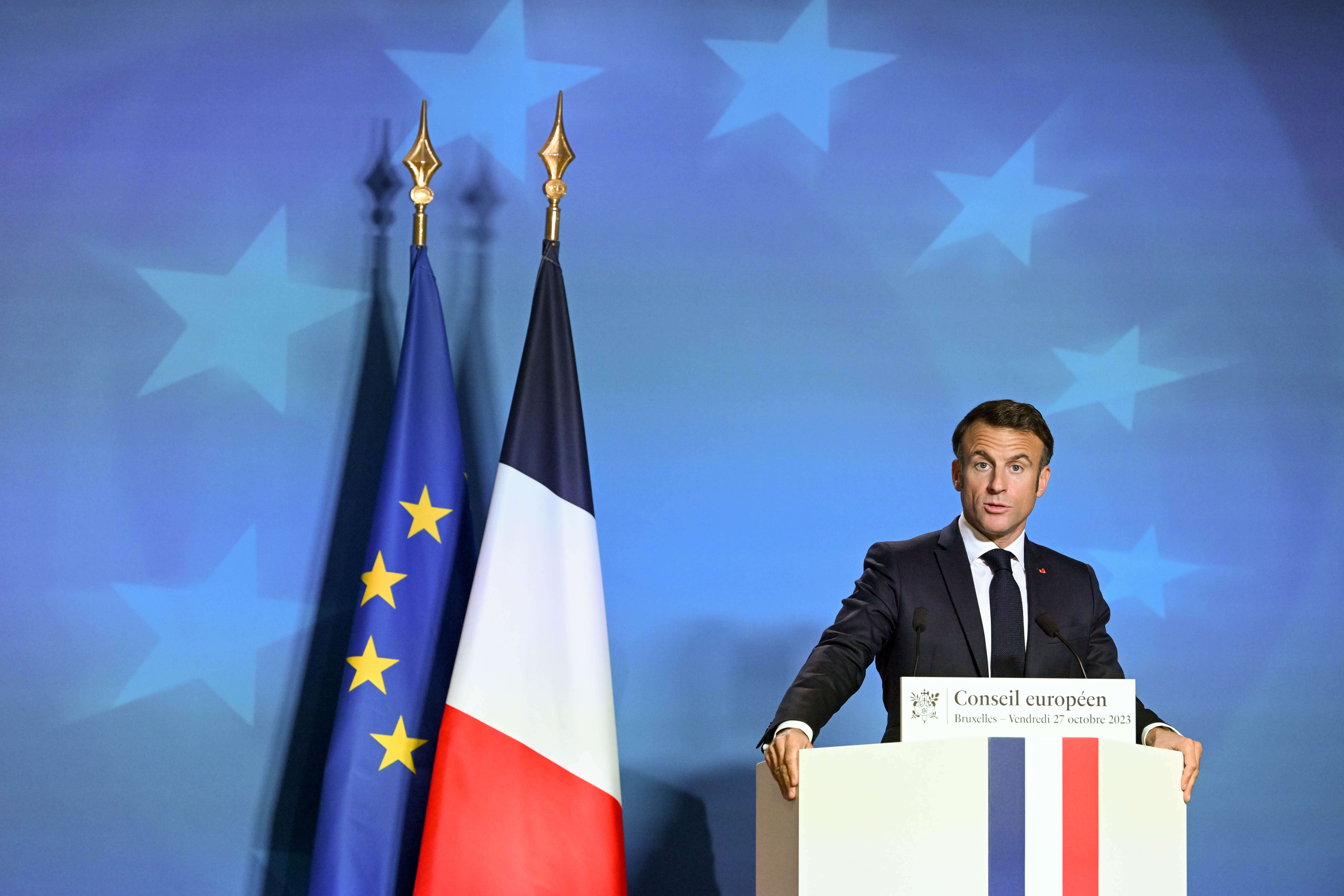 Macron used the current crisis in fossil fuel supply as an opportune moment to promote a nuclear alternative
After considerable internal debate, the EU supported French advocacy and accepted nuclear technologies as part of strategic net-zero technologies in 2024.
Thus, electricity production in nuclear plants has become an equal and desirable sector for achieving the European energy transition.
France will undoubtedly play a leading role in Europe in this process. It is at the heart of a new wave of interest in the installation of Small Modular Reactors (SMRs) in Europe. Many countries have recognised this faster, cheaper, and safer technological model as an opportunity to increase their energy capacities.
The French energy giant EDF announced at the end of last year that it will produce 30 SMRs by 2050, confirming that it is shifting its focus from building conventional large reactors to the production of SMRs, for which there is increasing global demand.
Their use keeps pace with new sources of demand for electricity, such as data centres and metallurgical complexes, while also becoming available to a much wider range of clients.
The re-nuclearisation of the European energy market seems not only possible but also increasingly likely to be an ongoing process.
Nuclear scepticism remains strong and widespread, but the enormous volatility in the global energy market outweighs fears and political caution. Recognition of the German strategic mistake is a small confirmation of the new European nuclear shift.
