The war in the Middle East is squeezing pocketbooks around the world, with governments, businesses, and households alike facing an energy-price spike and the prospect of higher inflation and interest rates.
As many observers have noted, European industry is being hit especially hard. Yet Europe is not entirely unprepared.
Under the banner of the European Union’s Digital Decade agenda, Europe is investing €207 billion ($244 billion) in digitalization by 2027 to protect its industries from shocks like the one emanating from the Gulf.
The goal is to strengthen digital skills, businesses, and connectivity to boost competitiveness, attract new trade partners, and multiply business opportunities.
To be sure, Europe’s apparent trade surplus in digital goods and services would seem to suggest that it is already more competitive than it was when the Digital Decade started six years ago.
Strong digital exports imply high productivity and global competitiveness in this crucial field.
New trade partnerships—like the recent deals signed with India, Mercosur (Argentina, Brazil, Paraguay, and Uruguay), and Australia—will encourage more technological innovation and production, extending the benefits of Europe’s digitally enhanced economy long into the future.
According to the European Commission, the Digital Decade will leave Europe economically stronger and strategically more flexible.
Europe’s digital trade surplus is an illusion
It’s a nice thought. Unfortunately, the Digital Decade’s targets remain out of reach. In fact, Europe’s digital trade surplus is an illusion.
As our co-authors and we show in a new report, excluding Ireland’s contribution from the European Union’s digital trade figures turns the surplus into a deficit.
Between 2022 and 2024, the gap reached $350.1 billion, almost 40% of what European governments plan to invest in defense by 2030.
Worse, in 2022 and 2023, the Irish tech sector created over six times more economic value than all other EU countries’ tech sectors combined.
Europe’s apparent digital trade performance largely reflects Ireland’s cozy relationship with US Big Tech
That means Europe’s apparent digital trade performance largely reflects Ireland’s cozy relationship with US Big Tech.
Boosting domestic tech production won’t help. Europe’s industrial tech leaders continue to depend heavily on digital imports—often from China—for manufacturing.
European customers spent roughly $529 billion more on Chinese digital products between 2020 and 2023 than was received via European sales to China.
Encouraging more digital production will lead to even more components being imported from China, at least in the near-term.
Europe needs partners
Nor are the European Commission’s wholly reactive policies and go-it-alone rhetoric helpful. Europe needs partners. But the way the Commission talks about the digital economy could make partnerships more difficult to forge.
The German Chambers of Commerce, for example, recently warned that “buy European” requirements could “undermine the EU’s credibility as a reliable partner that is committed to open and global trade worldwide,” thus undercutting European industry’s competitive position.
EU leaders must prepare much more ambitiously and comprehensively for intensifying global conflicts and their economic repercussions
That is no way to pursue digital sovereignty. More than ever, Europe finds itself squeezed between US Big Tech and Chinese manufacturers.
Yet its current policy approach—as represented by the Digital Decade—is unlikely to help.
EU leaders must prepare much more ambitiously and comprehensively for intensifying global conflicts and their economic repercussions.
Consistent and systematic industrial policy
We see four ways for Europe to recalibrate its dependencies. First, the European Commission must develop a consistent and systematic industrial policy.
If the goal is to reduce reliance on China, European industry will need to participate in more stages of the digital production chain.
The Commission should consider new investment structures or requirements to address the US-Ireland conundrum
The Commission should also consider new investment structures or requirements to address the US-Ireland conundrum.
One idea worth studying is an explicit preference for joint ventures or, more aggressively, incorporating “tech reciprocity” requirements into European screening of foreign direct investment.
Far from contradicting the Digital Decade vision, this would put it back on track.
Proactive trade policy
Second, Europe must develop a more strategic and proactive trade policy. That means focusing on partners that can deliver short-term gains in trade negotiations.
It also means looking for positive feedback effects in future trade relationships.
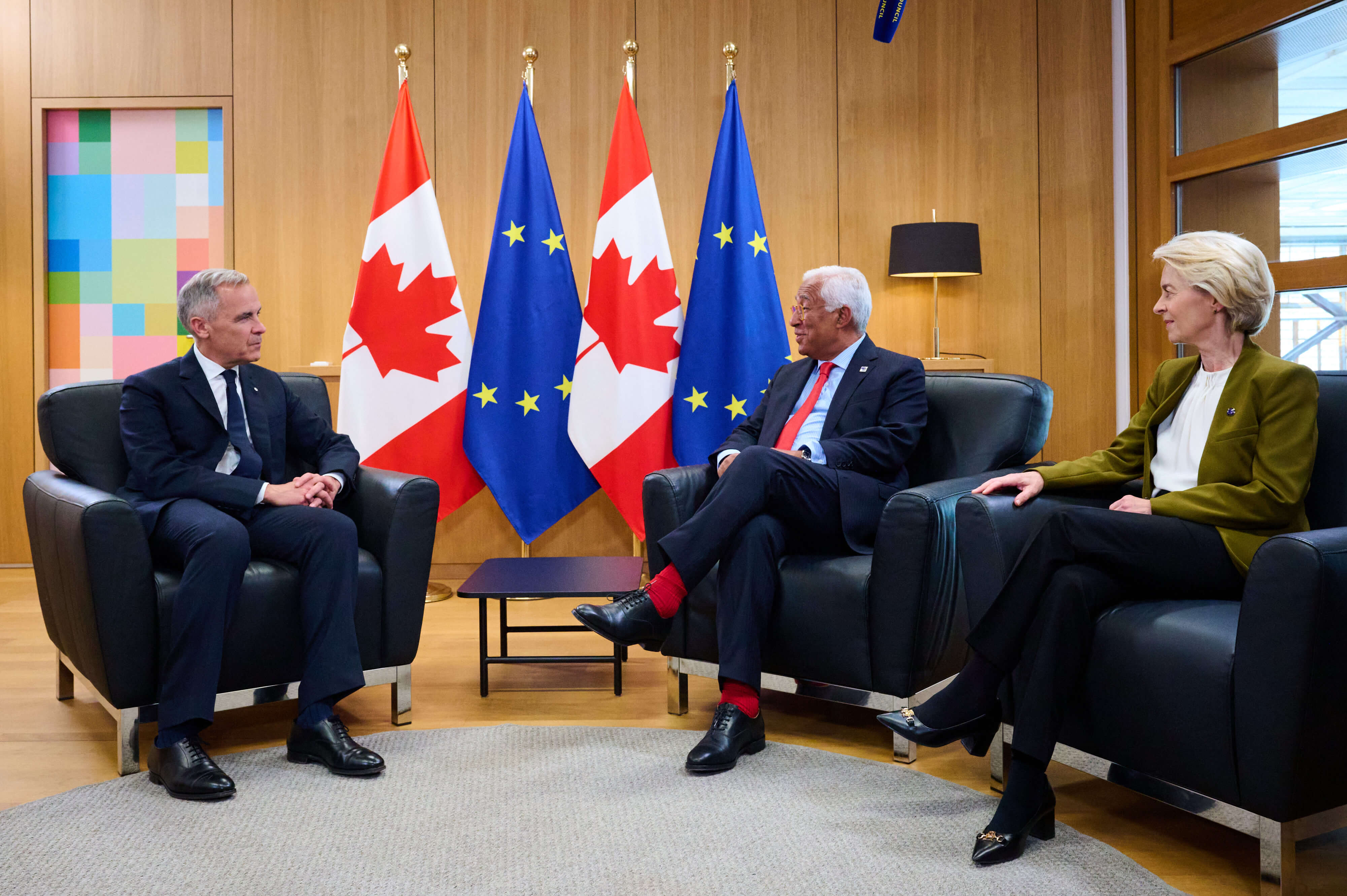 The positive reactions to Mark Carney’s speech at this year’s World Economic Forum meeting confirmed that multi-alignment remains attractive
One idea would be to fast-track, restart, or expand existing negotiations and agreements with countries like the United Arab Emirates, South Africa, and Saudi Arabia.
Although trade deals cannot create digital autonomy on their own, they can strengthen the material and technical foundation for it.
Third, Europe—and especially Germany—must increase investment in infrastructure and reverse negative net capital formation (when depreciation outpaces new investments) to foster innovation and strengthen its capacity to act.
The shocking revelation that the German government has misappropriated 95% of the funds allocated for infrastructure projects in 2025 to fill budget holes obviously sends the wrong signal. Europe is innovative.
But as the 2024 Draghi report showed, European innovation is not being converted into market advantage.
This problem cannot be addressed without sufficient financial support, nor by building on dilapidated or outdated physical and digital infrastructure.
Lastly, Europe needs to move from a narrative of self-reliance to one of collaboration and resilience through partnership.
While sovereigntist fantasies are increasingly prominent among governments, the positive reactions to Canadian Prime Minister Mark Carney’s speech at this year’s World Economic Forum meeting in Davos confirmed that multi-alignment remains attractive.
EU leaders should link these goals, promoting technological and other forms of cooperation to the reliable trade and investment partners Europe needs to become a more autonomous, less vulnerable economic and political actor and to start tackling the hard work it needs to undertake to secure its industrial future.
Laura Mahrenbach is an adjunct professor at the School of Social Sciences and Technology at the Technical University of Munich and a senior advisor at Cascade Advisory.
Maximilian Mayer is Junior-Professor of International Relations and the Global Politics of Technology at the University of Bonn.
