On 28 November, Taiwan held a referendum to abolish the ‘nuclear-free homeland’ policy.
The proposal secured both a majority of valid votes and the support of more than a quarter of all registered voters, as required by law for adoption.
However, the government had already begun the turnaround before the vote. President Lai Ching-te of the ruling Democratic Progressive Party, which implemented the reactor shutdown, announced on 21 March that preparations had begun to restart the Maanshan and Kuosheng nuclear power plants.
The referendum was proposed by the opposition Kuomintang and approved by parliament on 14 August.
It was held on the same day as the local elections, and the question was: ‘Do you support the government's use of nuclear power to revitalise the economy as a means of abolishing the 'nuclear-free homeland' energy policy?’
According to Article 30 of the Referendum Law, when voters approve a policy proposal, the president and the government must take steps to implement that policy.
The government had begun restarting the reactors on its own initiative and, until now, could have slowed down or abandoned the process. After the referendum, the law obliges it to continue that work.
The referendum, however, does not determine whether the reactors are safe to operate.
That is still being assessed by the Nuclear Safety Commission, the government body that oversees nuclear power plants.
It will grant permission to operate only when inspections show that the equipment can reliably function even after decades of use, that workers and the environment are protected from radiation, and that the facilities are sufficiently resistant to earthquakes.
Voters have already changed the law once
In a 2018 referendum, voters chose to delete from the Electricity Act a provision requiring nuclear plants to cease operation by 2025.
Removing that deadline did not extend any operating permits. The rules at the time required an application for renewal to be submitted at least five years before the licence expired.
After the referendum, there was still time for both Maanshan reactors in the south of the island, but the state power company Taipower, in line with government policy, did not submit applications.
The reactors were shut down one after the other as their licences expired, with the last Maanshan reactor shut down on 17 May 2025.
Three months later, there was a vote on restarting Maanshan. About 4.34 million voters supported the proposal, which was a majority of valid votes but less than a quarter of registered voters, so the proposal was not adopted.
As of May 2025, the law allows a licence to be renewed even after it has expired, for a maximum of twenty years, and Taipower applied to renew the licence for Maanshan on 27 March.
The referendum ended the ‘nuclear-free homeland’ policy. However, it did not change the law
The referendum ended the ‘nuclear-free homeland’ policy, that is, the government’s goal for Taiwan to completely abandon nuclear power plants.
However, it did not change the law. The Climate Change Response Act still states that the government should phase out nuclear power.
The government thus finds itself bound by two opposing obligations: the referendum requires it to restart the reactors, while the law requires it to abandon them. This contradiction can be resolved only by parliament, by amending the law.
The opposition Kuomintang and its allies, who proposed the referendum, hold a parliamentary majority.
Parliament can ask the government to state exactly how much it will cost to rebuild the reactor.
Maanshan in 2028 at the earliest, Kuosheng only after the fuel is removed
On 24 September, the Nuclear Safety Commission approved Taipower's plan to restart Maanshan.
Approval of the plan is not yet an operating permit. Taipower must now determine the condition of the equipment, replace defective parts and assess the plant's earthquake resistance, after which the Commission will verify the findings on site.
Economy Minister Kung Ming-hsin previously estimated that Taipower could submit a report on these checks to the Commission in mid-2027 at the earliest and that Maanshan could be operational in 2028 if all goes according to plan.
The Ministry of Economy assessed as early as November 2025 that reconstruction is feasible at both Maanshan and Kuosheng, but that Kuosheng will take longer.
The fuel has not yet been removed from the reactors, so none of them can be inspected internally
Kuosheng is located in the north of the island, in New Taipei, and its last reactor was shut down in March 2023.
To inspect the inside of the reactor, the spent fuel must first be removed and placed in dry storage in sealed steel and concrete containers outside the reactor building.
The Commission approved the construction of a storage facility in 2015, but Taipower's dispute with the New Taipei city authorities lasted for almost a decade, so the city did not give the necessary consent until 2024. The storage facility was completed in August 2026.
The storage facility was completed, and by mid-November only part of the old fuel from the pool next to the reactor had been moved into it.
The fuel has not yet been removed from the reactors, so none of them can be inspected internally.
In September, Taipower requested permission to begin some of the checks before fully removing the fuel, but it requires approval from the Nuclear Safety Commission.
Growth in consumption over two years equals Maanshan’s total output
In 2025, gas-fired power plants produced 138.2 terawatt-hours (billions of kilowatt-hours) of electricity, accounting for 47.7 per cent of total production in Taiwan, according to data from the Taiwan Energy Administration. This was 15.7 terawatt-hours more than a year earlier.
Around nine terawatt-hours of this increase replaced electricity previously supplied by decommissioned nuclear power plants, while coal-fired generation also declined at the same time.
Both Maanshan reactors, each with a capacity of 951 megawatts, would generate about 15 terawatt-hours per year at 90 per cent utilisation.
Electricity consumption will grow by an average of 2.5 per cent annually until 2035, primarily due to new chip factories and data processing centres
In June, the Ministry of Economy estimated that electricity consumption will grow by an average of 2.5 per cent annually until 2035, primarily due to new chip factories and data processing centres.
That means about seven billion kilowatt-hours more every year. Within two years, consumption would therefore increase by as much electricity as Maanshan produces in one year.
The electricity from the restarted reactors would mainly be used to cover new demand, and even after their return, Taiwan would probably not use less gas than it does today.
A comparison with a single company shows how much electricity this represents.
Chipmaker TSMC's facilities in Taiwan, together with affiliate VisEra, consumed about 26 terawatt-hours in 2025, nearly three-quarters more than Maanshan would produce.
If Kuosheng, whose two reactors have a capacity of 985 megawatts each, were also operating, the two plants together would produce about 31 terawatt-hours per year, only slightly more than TSMC's consumption.
Eleven days of reserves show how long Taiwan can hold out
The law stipulates that Taiwan must maintain gas reserves sufficient for at least eleven days of consumption, rising to at least fourteen days from 2027. A minimum of thirty days is required for coal and ninety days for oil.
All imported gas arrives by ship in liquid form because the island does not have a gas pipeline to any other country.
On 29 and 30 December 2025, during manoeuvres around Taiwan, the Chinese army practised blocking the main ports and sea approaches to the island.
In such a blockade, even gas that Taiwan has already paid for from a supplier on the other side of the world would not reach the terminal.
This vulnerability was also evident this year, when the war with Iran disrupted navigation through the Strait of Hormuz, the route used by tankers from the Persian Gulf.
In 2025, Qatar supplied about a third of Taiwan's LNG imports. The value of imports from Qatar fell in the first four months of 2026 by 38.5 per cent compared with the same period of the previous year, which the Ministry of Finance attributed to disrupted navigation.
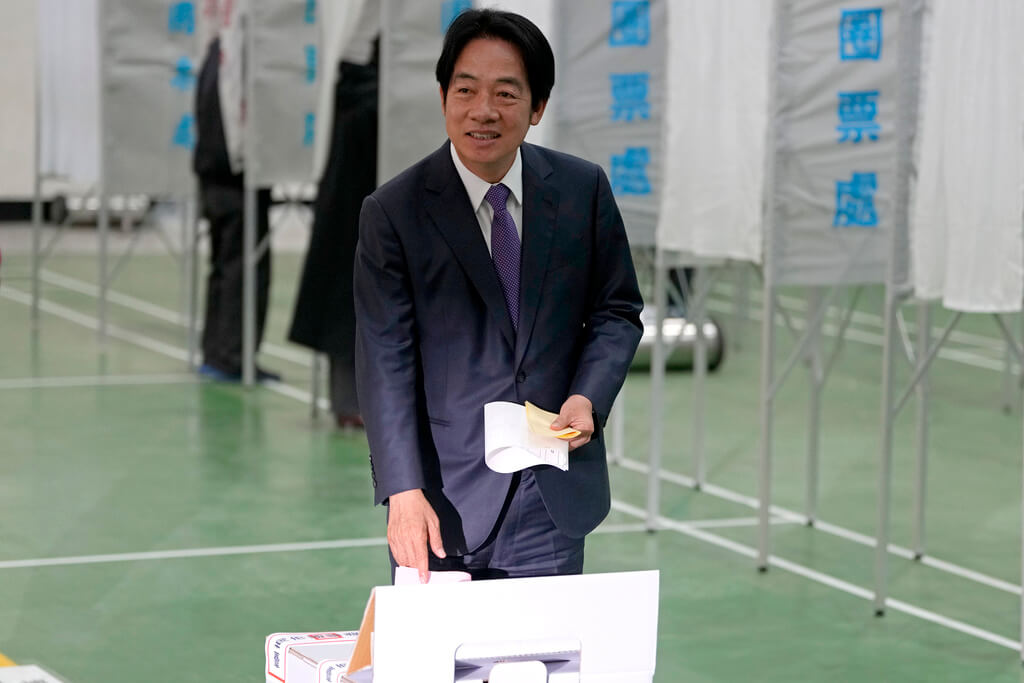 President Lai Ching-te said in March that Taiwan would have gas for only 12 to 14 days, and in the same speech he announced preparations for reinstating the reactors
.
He justified their reinstatement by citing growing consumption and the need for electricity with lower carbon dioxide emissions.
A nuclear power plant takes delivery of new fuel only every one and a half to two years.
Maanshan could therefore continue generating electricity even when gas tankers fail to arrive. It would not extend supplies by much, however.
Maanshan would have produced about 11 per cent of the electricity generated by gas power plants in 2025.
If the power plants used that much less gas, supplies sufficient for eleven days would last about twelve.
Since gas is consumed by both factories and households, the actual gain would be even smaller.
In the event of a longer interruption to supplies, the crucial question is therefore how much gas Taiwan can keep in storage.
The gas contracts will remain in force even after the reactors return
Taiwan has already bought gas years in advance. State importer CPC has signed long-term contracts with the US company Cheniere and the Qatari state company QatarEnergy, under which it will receive a total of about seven million tonnes of liquefied gas annually, mostly until 2045 and beyond.
Those contracts will also remain in force when the reactors return, at the earliest in 2028.
It is not clear from the published terms whether CPC is allowed to take less gas than it has contracted for if it needs less after the reactors return.
The government is most likely to continue preparations at Maanshan during 2027 and maintain its planned gas purchases
The government in Taipei is most likely to continue preparations at Maanshan during 2027 and maintain its planned gas purchases.
The Ministry of Economy’s plan from June predicts that about 26 gigawatts of new gas-fired power plants will be operational within ten years.
That figure is the total capacity of new state-owned and private plants, without deducting plants that will be shut down.
Once the reactors are operational, some gas-fired power plants could operate less frequently and serve as reserve capacity for peak-demand days.
The government has not yet announced how much it will cost to rebuild Maanshan and Kuosheng, including the storage of spent fuel.
It has also not stated how much gas Taiwan will need to buy with these two power plants in operation, and how much it will need without them.
Without those figures, neither parliament nor the public can assess whether returning the reactors to service is worthwhile.
Whether the return of nuclear power has really changed Taiwan’s supply situation will be clear only when CPC orders less gas for the first time and attributes that decision to the reactors being operational.
