Will ousted leader Sheikh Hasina return from her Indian exile next month or is she just using this purported plan to rally her supporters and destabilise Bangladesh’s government?
Since mid-November, Bangladesh has suffered violence including explosions, arson and road blockades blamed on backers of Hasina’s Awami League party. No let-up is in sight, given her adamant stance that she will return on 16 December, claiming her country needs her and that she would rather die on her native soil.
The political unrest will do little to fix an economic crisis but reform is vital if the government led by Prime Minister Tarique Rahman of the Bangladesh Nationalist Party is to retain control.
The government is hoping to finalise a plan with the International Monetary Fund by January as part of efforts to address the looming insolvency faced by many Bangladeshi banks and to bolster growth.
Delayed graduation and a vow to come back
This week, the country should have been celebrating its graduation from the UN’s category as one of the world’s least developed countries (LDCs) and join the group of developing countries. But Bangladesh, and Nepal, requested a delay until 2029.
Bangladesh does meet many of the criteria to move up, but it pointed to weaknesses in the banking sector and energy supply, as well as unpredictable trade. The country would have lost the preferential trade terms and financing given to LDCs.
She can only return via formal extradition from India “in handcuffs or under strict surveillance”
In the meantime, Hasina continues to pose a grave headache for the government since she was forced into exile two years ago after a mass uprising ended her 15-year rule.
Bangladesh sentenced her to death for crimes against humanity after hundreds of people were killed in the uprising but the fear of arrest and death has not deterred her vow to come back.
She plans to return on Victory Day, marking Bangladesh’s 1971 breakaway from Pakistan and war of independence, led by her father, Sheikh Mujibur Rahman. “We firmly believe that she will celebrate this historic day among her people,” said her aide Abu Obaidha Arin.
She has urged the government to issue her a passport and fly her back, but it says she can only return via formal extradition from India “in handcuffs or under strict surveillance,” Humaium Kobir, junior minister for foreign affairs, told reporters this week.
Great strides and an immunisation gap
Bangladesh has made great strides since independence, including a big fall in the number of people living in poverty from around 80% to some 18%, although contradictions abound.
This month it became the 33rd country in the world to produce and generate nuclear power, Fakir Mahbub Anam, the science and technology minister, proudly told reporters at the Rooppur nuclear power plant built with Russian know-how. The plant fed electricity into the grid for the first time in a test on 17 November.
But Bangladesh is also in the grip of a measles outbreak after apparent administrative failures led to disrupted vaccine procurement. Confirmed and suspected measles-linked fatalities total 1,352 people so far this year, according to local media.
The death sentence on Hasina and a ban on the Awami League were imposed during Yunus’ rule
Hasina said last month that the “epidemic” was the result of “state negligence”. She blamed the former Muhammad Yunus-led interim administration of disrupting vaccine procurement and creating an immunisation gap.
Yunus is the founder of the Nobel-winning microcredit lender Grameen Bank and he served as head of the interim government after Hasina’s ousting until February, when Rahman won an overwhelming majority in national elections.
The death sentence on Hasina and a ban on the Awami League were imposed during Yunus’ rule. Meanwhile, Grameen recorded 97 attacks on branches and offices led by Hasina supporters between 10 and 23 November, Al Jazeera reported.
A “culture of bank plunder”
Other Bangladeshi banks are also suffering grave challenges, which have been blamed on an excessive relaxation of financing rules and corruption. “The sector was first ruined by a culture of loan default. After 2010, we came out of that but now we face a culture of bank plunder, which is even more dangerous, where money is taken away without any rules,” Wahiduddin Mahmud, former adviser for planning to the interim government, recently told a banking conference.
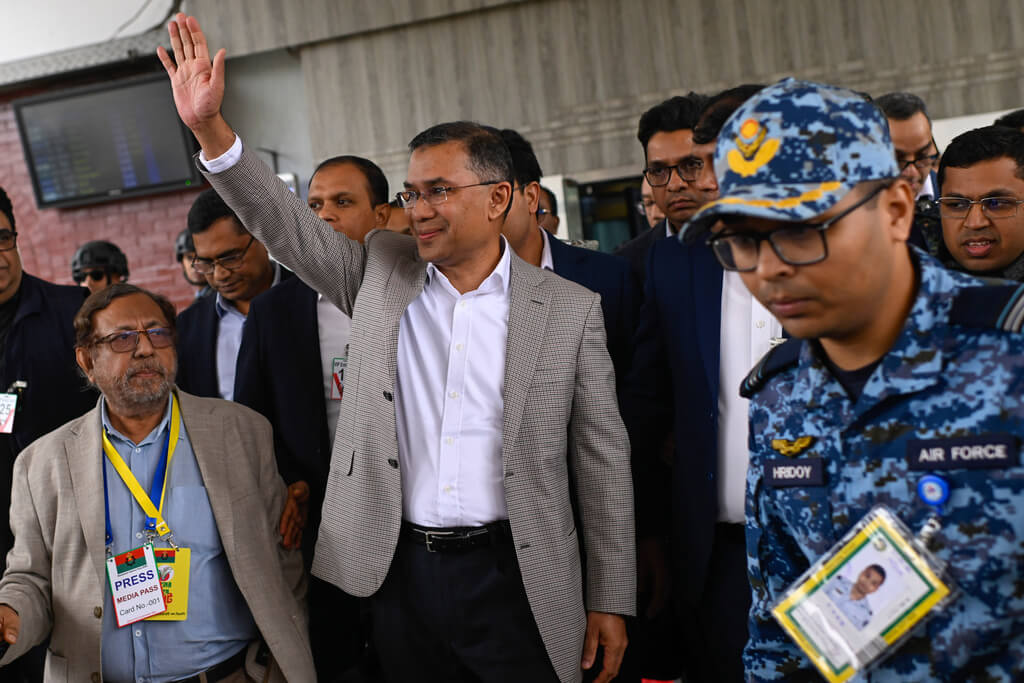 The obstacles to stable rule appear to be mounting daily for Tarique Rahman, himself a product of dynastic politics like Hasina as the son of Khaleda Zia, the country’s first female prime minister
The garments sector - the world’s second-largest after China and which accounts for more than 80% of Bangladesh’s export earnings - has been crippled by a weeks-long strike that has cost at least $428 million, the Bangladesh Garment Manufacturers and Exporters Association said on 23 November. Orders worth $254 million have moved to other countries, it said.
The obstacles to stable rule appear to be mounting daily for Rahman, himself a product of dynastic politics like Hasina as the son of Khaleda Zia, the country’s first female prime minister.
His ties with New Delhi have been strained by Hasina’s exile and he has failed to make an official visit to India since taking office and he even missed the Brics summit there in September.
Furthermore, the recent violence has spread abroad with a reported attack by Awami supporters who armed with sticks swarmed a London reception on 17 November for Nahid Islam, who was part of the uprising against Hasina and is a member of the Bangladeshi parliament, the Daily Star newspaper reported.
Keeping a lid on the spiralling unrest is vital if the IMF and other investors are to be kept onside.
